
Patents, specs, brochures and product imagery.
Seventeen provisional applications across Moseley (semiconductor contamination) and Ambient IoT (fresh-produce ethylene), including the Moseley Climacteric Architecture umbrella (AU 2026904577), the E-Aegis device (AU 2026904657) and the E-MCP distributed-release filing (AU 2026905019). Click any patent to expand the plain-English explanation, listen to a short audio briefing, and view the filing document.
Portfolio Infographics
3 infographicsPatent Portfolio Architecture 17 provisional applications across 4 integrated tiers · May 2026
Current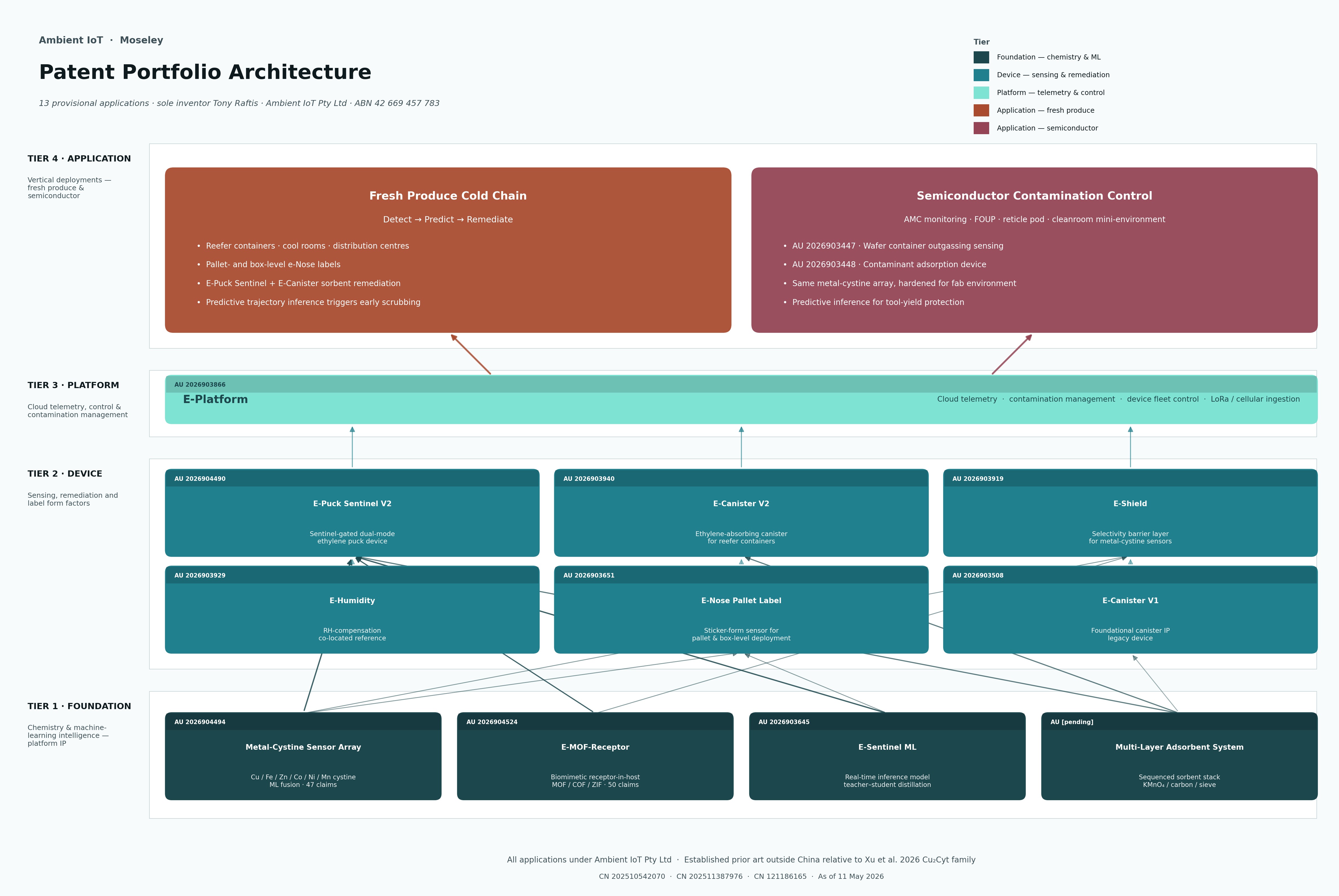
What it shows
A layered architecture diagram of all 17 Ambient IoT and Moseley provisional applications, organised into four integrated tiers: Foundation (Metal-Cystine Sensor Array, E-MOF-Receptor, E-Sentinel ML, Multi-Layer Adsorbent System) → Device (E-Aegis, E-Canister V1/V2, E-Shield, E-Humidity, E-Nose Pallet Label) → Platform (E-Platform telemetry and control) → Application (Fresh Produce Cold Chain on the Ambient IoT side, Semiconductor Contamination Control on the Moseley side, drawing on AU 2026903447 and AU 2026903448).
Arrows show how the foundation chemistry and ML feed specific devices, how all device telemetry flows up through the E-Platform, and how the platform serves the two vertical applications.
Why it matters
This is the integration map that demonstrates the portfolio is a coherent system rather than a list of independent filings. It also makes explicit Ambient IoT's prior-art position outside China relative to the Xu et al. 2026 Cu₂Cyt family (CN 202510542070, CN 202511387976, CN 121186165) — every device, the platform, and both vertical applications sit on top of the two Foundation-tier genus filings: AU 2026904494 (Metal-Cystine Sensor Array) and AU 2026904524 (E-MOF-Receptor, receptor-in-host integration).
Moseley Patent Portfolio · Ethylene Intelligence in Cold-Chain Logistics A system, not just a sensor · 6-layer integrated platform · May 2026
Current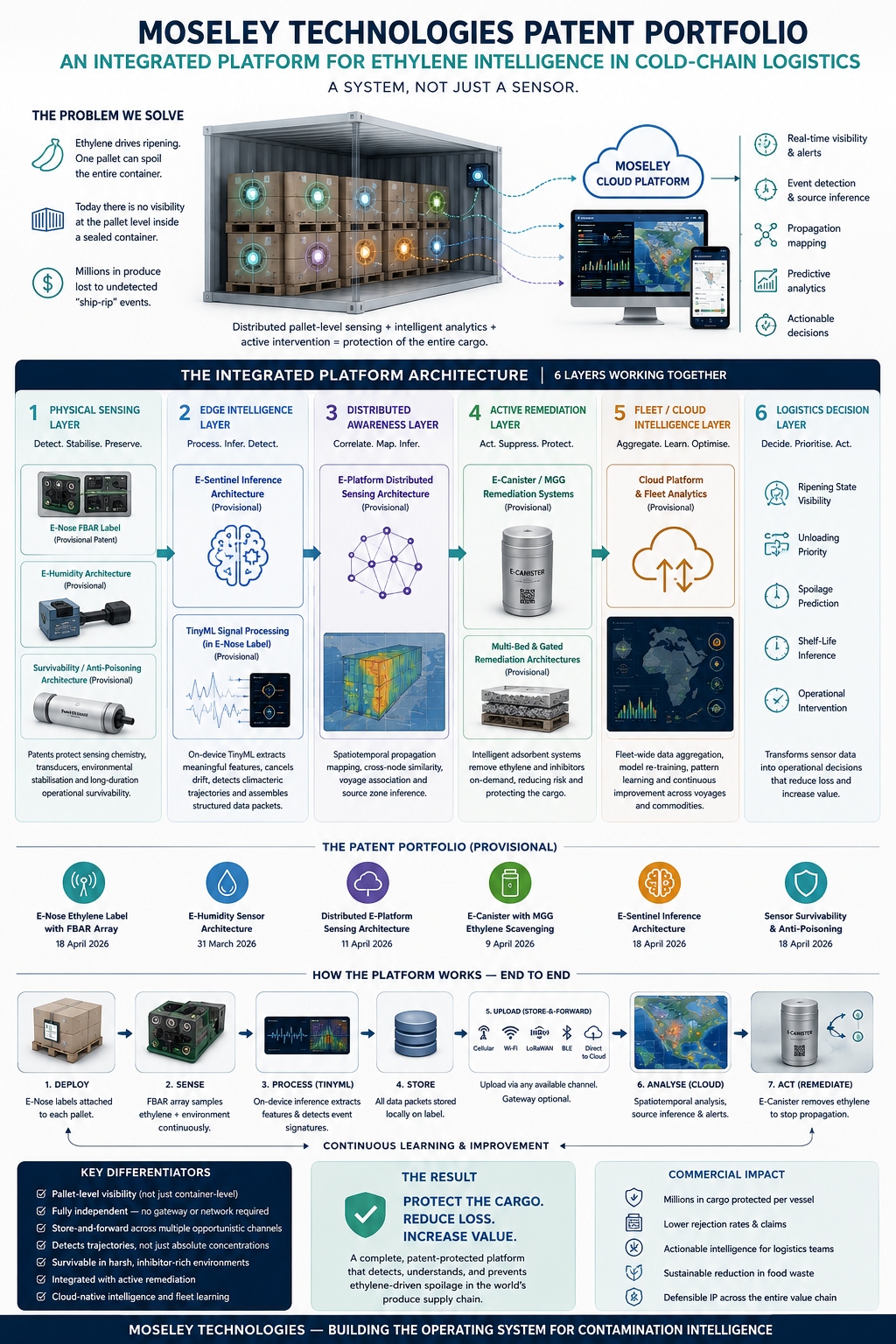
What it shows
The full Moseley / Ambient IoT platform story for fresh-produce cold chain: pallet-level E-Nose sensing inside a sealed container, edge TinyML on the label, distributed spatiotemporal awareness across the cargo, active E-Canister remediation, fleet / cloud analytics, and operational decisions back to the logistics team.
The infographic maps each layer to the underlying provisional filings (E-Nose Pallet Label AU 2026903651, E-Sentinel ML AU 2026903645, E-Platform AU 2026903866, E-Canister V1/V2 AU 2026903508 / 903940, E-Humidity AU 2026903929, E-Shield AU 2026903919, Multi-Layer Adsorbent System) and walks through the end-to-end flow: Deploy → Sense → Process (TinyML) → Store → Upload → Analyse → Act (Remediate).
Why it matters
This is the BD-facing single-page explanation of the cold-chain side of the portfolio for operators, insurers and partners (AgroFresh, Hill Group, Monash). It frames the IP not as discrete patents but as one operating system: distributed pallet-level sensing + intelligent analytics + active intervention = protection of the entire cargo, with defensible IP across the entire value chain.
Fresh Produce Ethylene Platform · Sense → Decide → Remediate E-Aegis + E-Sentinel ML + Multi-Bed Adsorbent · technical view · May 2026
Current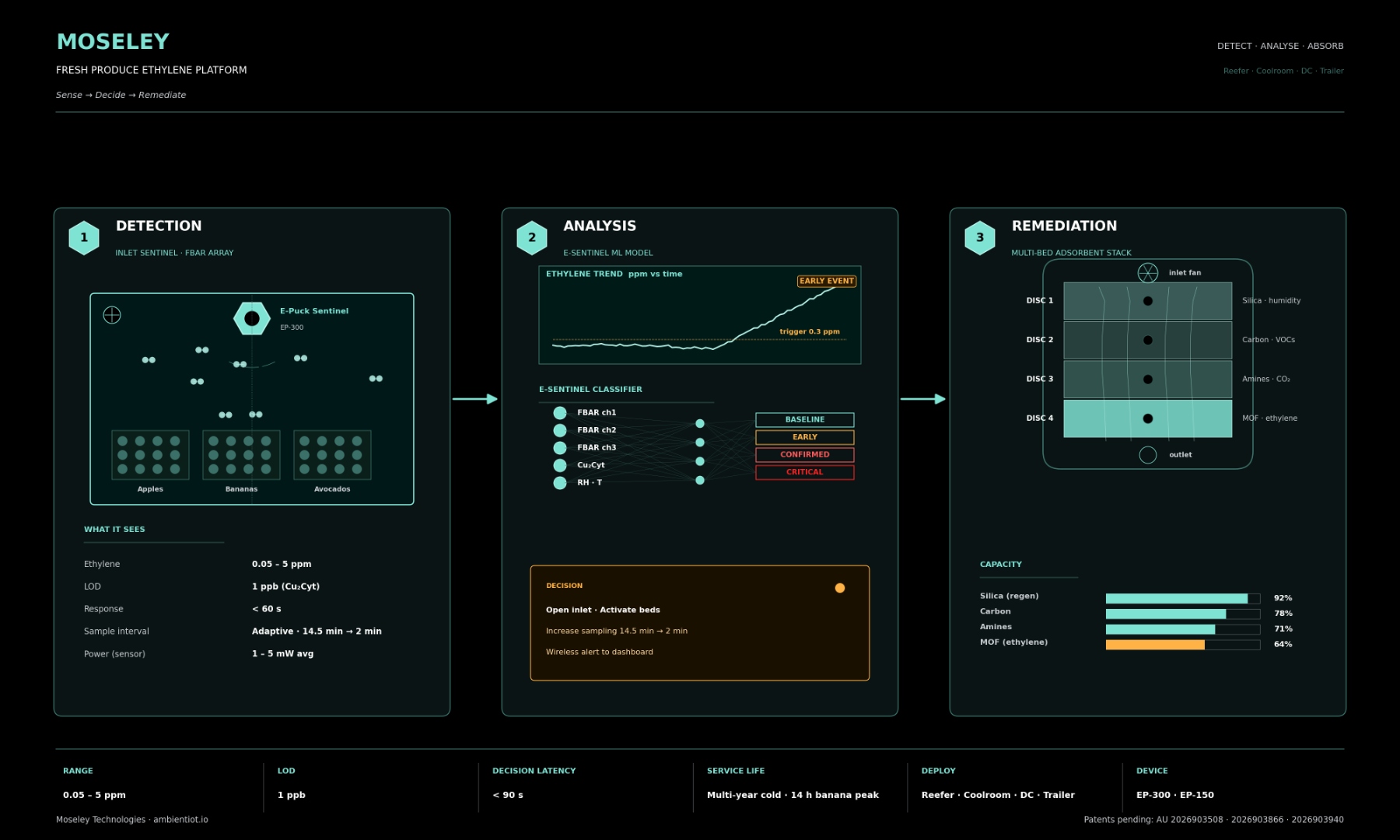
What it shows
The technical three-stage view of the produce platform:
- Detection — E-Aegis inlet with FBAR array, ethylene 0.05–5 ppm, LOD 1 ppb (Cu₂Cyt), <60 s response, adaptive sampling 14.5 min → 2 min, 1–5 mW average sensor power.
- Analysis — E-Sentinel ML model fuses FBAR ch1–3 + Cu₂Cyt + RH/T into Baseline / Early / Confirmed / Critical states; opens inlet, activates beds, increases sampling, alerts dashboard.
- Remediation — Multi-bed adsorbent stack (silica/humidity, carbon/VOCs, amines/CO₂, MOF/ethylene) with live capacity telemetry per disc.
Footer specs: range 0.05–5 ppm, LOD 1 ppb, decision latency <90 s, multi-year cold · 14 h banana peak service life, deploy across reefer / coolroom / DC / trailer, single E-Aegis device with three modifiable layers.
Why it matters
This is the engineer-facing companion to the portfolio diagram — concrete numbers a reviewer or partner can stress-test. It also makes the link to the underlying provisional filings explicit: AU 2026903508 (E-Canister V1), AU 2026903866 (E-Platform), AU 2026903940 (E-Canister V2), with the Cu₂Cyt sensing channel anchored to the Metal-Cystine Sensor Array genus filing AU 2026904494.
Confidential Briefings
1 documentPre-Trilateral Briefing Memo · Prof. Matthew R Hill Hill Applied Porous Materials Team · 11 May 2026 · 17:14 AEST · Confidential
CurrentWhat this is
Diligence brief prepared ahead of the next conversation with Prof. Matthew Hill's group at Monash University and CSIRO. Covers Hill's commercial profile (CTO of MOFWorx, 10 kg/hour continuous-flow MOF manufacture), patent portfolio, 2024–2026 publications, CSIRO licensing posture, and conflict checks against Wu / Henan / AgroFresh / Cu₂Cyt-author lines.
“No IP conflict. No competitor entanglement. Hill brings the host at scale; Ambient IoT brings the receptor, the device, the ML and the platform.”
Why it matters for Ambient IoT
Hill's IP sits upstream (MOF synthesis, gas-separation membranes); Ambient IoT's portfolio sits downstream (sensor, remediation, ML, platform). Ideal complementarity. The recommended deal shape is license-in plus MOFWorx supply — not a foreground-IP transfer. Background IP that must remain unencumbered: AU 2026904494 (Metal-Cystine Sensor Array genus), AU 2026904524 (E-MOF-Receptor genus, filed 11 May 2026), AU 2026903447 / AU 2026903448 (Moseley wafer-container and adsorption filings), and the wider E-family.
Joint Pitch Decks
1 deckContamination Intelligence & Control Stack Vocus + MMCC · FOUP-level AMC control · 11 slides · May 2026
Current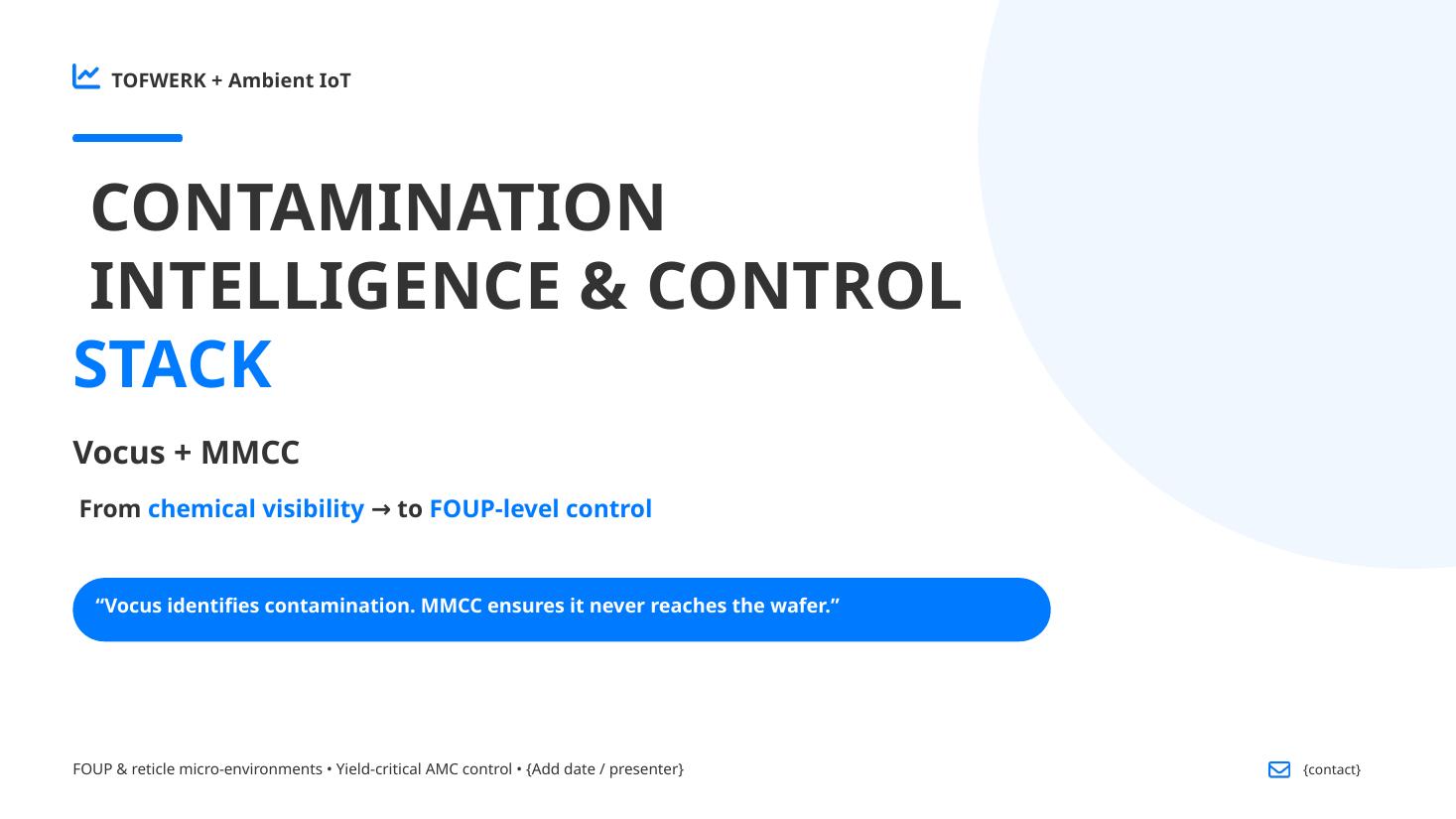
What this is
A joint TOFWERK / Ambient IoT pitch deck combining Vocus high-resolution proton-transfer-reaction mass spectrometry for fab-wide molecular identification with MMCC (Moseley Micro-environment Contamination Control) embedded sensing and remediation inside FOUPs and reticle pods.
“Vocus identifies contamination. MMCC ensures it never reaches the wafer.”
The deck walks through a four-layer integration workflow: Discovery (Vocus identifies AMC species at fab scale) → Model Translation (signatures translated into embedded model targets) → Embedded Control (MMCC E-Aegis devices deployed inside FOUPs / reticle pods) → Feedback (in-pod telemetry returns to fab-level Vocus context).
Why it matters
This deck closes the gap between fab-level chemical truth (Vocus) and embedded, always-on AMC control at the wafer micro-environment. It positions Moseley's MMCC stack as the FOUP- and reticle-level execution layer for Vocus discovery, sitting directly on top of the Moseley provisional filings AU 2026903447 (Wafer container outgassing sensing) and AU 2026903448 (Contaminant Adsorption Device), and drawing on the broader Metal-Cystine Sensor Array genus (AU 2026904494) for predictive AMC detection.
Internal Strategic Briefs
2 documents · Ambient IoT internal onlyThe biomimetic Cu(I) ethylene receptor: significance, competitive position, and implications for Ambient IoT Internal strategic assessment · 11 May 2026 · 17:14 AEST · 10 pages
InternalWhat this brief is
A confidential internal assessment of the April 2026 Xu et al. Nature Communications paper and the wider research line led by Prof. Junfeng Wu at Henan Agricultural University. Covers the chemistry, the performance numbers (1.07 ppb LOD, room-temperature, noble-metal-free, biomimetic Cu(I)-S coordination), why the chemistry plausibly breaks the cold-chain selectivity barrier no engineered chemistry has yet cleared, and what it means for Ambient IoT's deployment route, IP architecture and collaboration posture.
Sections
§1 What was published & why it is novel — chemistry, performance table vs Chen/Stanciu 2020 and commercial electrochemical, what is genuinely new vs not. §2 The Wu research line and its trajectory — Henan lab, three CN filings, readback of Wu's 10 May reply. §3 Why this matters commercially — selectivity barrier, market sizing, why Ambient IoT is the right integration partner via AgroFresh. §4 IP implications & counter-portfolio position — all seven core AU filings mapped against the Xu/Wu chemistry, with precise framing of what AU 2026904494 (Metal-Cystine Sensor Array genus) and AU 2026904524 (E-MOF-Receptor genus) do and do not claim. §5 Risks & adverse scenarios — chemistry survival, competing licensee, PCT extension, attribution. §6 Six concrete recommendations — MNDA this week, phased collaboration proposal, monitor cadence, Hill MOFWorx in parallel, pre-PCT adversarial review, AgroFresh briefing.
Strategic posture
Treat Wu's chemistry as a foundation to build on, not a threat to defend against. The Ambient IoT portfolio is already structured to own the value above the chemistry — the array, the host, the prediction, the drift-mitigation, the device, the platform, the deployment channel. Securing collaborative access to the chemistry on friendly terms converts a multi-year scientific risk into a 12–24 month product programme.
Researching biomimetic ethylene sensing — the cuprous-cystine receptor and the integrated Ambient IoT sensing architecture Internal strategic assessment · 11 May 2026 · 17:14 AEST · 13 pages (cover + body)
InternalWhat this assessment covers
A deeper technical companion piece to the strategic brief. Walks the science end-to-end: the historical biology (ETR1 receptor, Rodriguez/Bleecker 1999, Cu(I)–cysteine coordination, RAN1 chaperone), the synthetic externalisation of that biology in the Xu/Wu Cu₂Cyt complex, the Dewar-Chatt-Duncanson π-complexation physics that explains the selectivity, the MXene (Ti₃C₂Tₓ) heterojunction transduction mechanism and the dual-site DFT adsorption picture. Then maps that science onto the Ambient IoT integration stack — E-Aegis, the E-Platform, the drift-mitigation and ML layers — and the IP architecture that surrounds it.
How this differs from the Strategic Brief
The first brief is a posture document — short, board-ready, focused on what to do this week (MNDA, AgroFresh, Hill Group, monitor). This second document is the technical underpinning — longer, more chemistry-heavy, and intended as the reference any internal reader (or, post-MNDA, any external collaborator under NDA) can use to understand why Cu₂Cyt matters at the molecular level and how it slots into the Ambient IoT architecture. Read together they cover the science, the strategy, and the IP perimeter.
Cited Prior Art
1 documentA plant-receptor-inspired cuprous complex for wearable trace-level ethylene gas sensing Xu et al. · Nature Communications · 2026 · DOI 10.1038/s41467-026-71748-7
Prior ArtWhat this paper is
The Xu group at Henan Agricultural University, Nankai University and Zhengzhou University describe a wearable, room-temperature, noble-metal-free chemiresistive ethylene sensor based on a biomimetic cuprous-cystine coordination complex they call Cu₂Cyt. The complex copies the sulfur-bridged Cu(I) binding site that plant ethylene receptors use to detect the hormone, giving high specificity for C₂H₄ without platinum, palladium or ruthenium catalysts.
The Cu₂Cyt / MXene composite is printed onto flexible interdigital electrodes and operates at room temperature. Reported performance: detection range 0.05–5 ppm, detection limit 1.07 ppb, response/recovery 51 / 92 s, sensitivity 3.64 %·ppm⁻¹ in the 0–0.5 ppm range, with good reversibility and reproducibility. Demonstrated on fruit emissions and simulated industrial pipeline leaks.
Why it matters for Ambient IoT
This is the foundational Cu(I)-cystine reference. The associated Chinese filings (CN 202510542070, CN 202511387976, CN 121186165) are tracked monthly by the Cu2Cyt patent monitor; no PCT / US / EP family members have been observed. Ambient IoT treats this paper and the Chinese filings as prior art outside China, and the counter-portfolio establishes priority on the array architecture, ML fusion, predictive trajectory inference and semiconductor AMC embodiments — most recently AU 2026904494 (Metal-Cystine Sensor Array, filed 10 May 2026).
Video Library
Platform walkthroughs and technical explainer videos.Moseley Climacteric™ Platform Platform overview · 4:03 · 164 MB · hosted on Google Drive
AvailableFull narrated walkthrough of the Moseley Climacteric™ biological sensing platform — the problem with metal-oxide sensors, the cuprous-cystine biomimetic receptor, the E-Aegis / E-MCP / E-Nose / E-Sentinel / E-Remediation architecture, and the Biological Passport.
Audio Library
Every audio briefing and explainer on the Moseley site.Researching Biomimetic Ethylene Sensing
Strategic assessment briefing · brief-researching-biomimetic.mp3
Available
Wu Biomimetic Ethylene Receptor
Strategic briefing · brief-wu-strategic.mp3
Available
Moseley Climacteric Platform
Platform overview · climacteric_audio_01_platform.mp3
Available
E-Aegis
Environmental intelligence gateway · climacteric_audio_02_eaegis.mp3
Available
E-Conditioning
Environmental conditioning subsystem · climacteric_audio_03_econditioning.mp3
Available
E-Array
Metal-cystine sensor array · climacteric_audio_04_earray.mp3
Available
E-Remediation
Active ethylene remediation · climacteric_audio_05_eremediation.mp3
Available
E-MCP
Multi-bed remediation device · climacteric_audio_06_emcp.mp3
Available
E-Nose Pallet Label
Distributed biological sensing label · climacteric_audio_07_enoselabel.mp3
Available
E-MCP (extended)
Multi-bed control point — extended brief · climacteric_audio_08_mcp.mp3
Available
E-Nose Ethylene
Product explainer · enose_explainer_v2.mp3
Available
Teacher–Student ML Pipeline
Cloud-trained → TinyML edge inference · teacher-student.mp3
Available
Patent · Wafer Container Sensing
AU 2026903447 · p01_wafer_container_sensing.mp3
Available
Patent · Contaminant Adsorption Device
AU 2026903448 · p02_contaminant_adsorption_device.mp3
Available
Patent · E-Canister V1
AU 2026903508 · p03_ecanister_v1.mp3
Available
Patent · E-Sentinel ML
AU 2026903645 · p04_esentinel_ml.mp3
Available
Patent · E-Nose Pallet Label
AU 2026903651 · p05_enose_pallet_label.mp3
Available
Patent · E-Platform
AU 2026903866 · p06_eplatform.mp3
Available
Patent · E-Shield
AU 2026903919 · p07_eshield.mp3
Available
Patent · E-Humidity
AU 2026903929 · p08_ehumidity.mp3
Available
Patent · E-Canister V2
AU 2026903940 · p09_ecanister_v2.mp3
Available
Patent · Multi-Layer Adsorbent System
Provisional · 4 May 2026 · p10_multilayer_adsorbent_system.mp3
Available
Patent · Metal-Cystine Sensor Array
AU 2026904494 · p12_metal_cystine_sensor_array.mp3
Available
Prior Art · Xu et al. Cu₂Cyt
Nature Communications 2026 paper briefing · r01_xu_cu2cyt_paper.mp3
Available
Internal Applications
Operational tools and asset repositories. Additional access password required.Google Drive Asset Catalogue 32,779 records · images, decks, PDFs, briefs · gallery, search & filtering
RestrictedComplete index of the Moseley / Ambient IoT Google Drive estate — product imagery, infographics, decks, briefs, patent figures, research PDFs and audio. Browse by category, search by keyword, filter by type, and open each asset directly in Drive. Includes deck-extracted cover thumbnails for fast visual scanning.
Upload to Library
Files post to the Moseley Technical Library storage. Images, PDFs, decks, Word docs, video — all welcome.
Library
⚠ Upload endpoint unreachable.