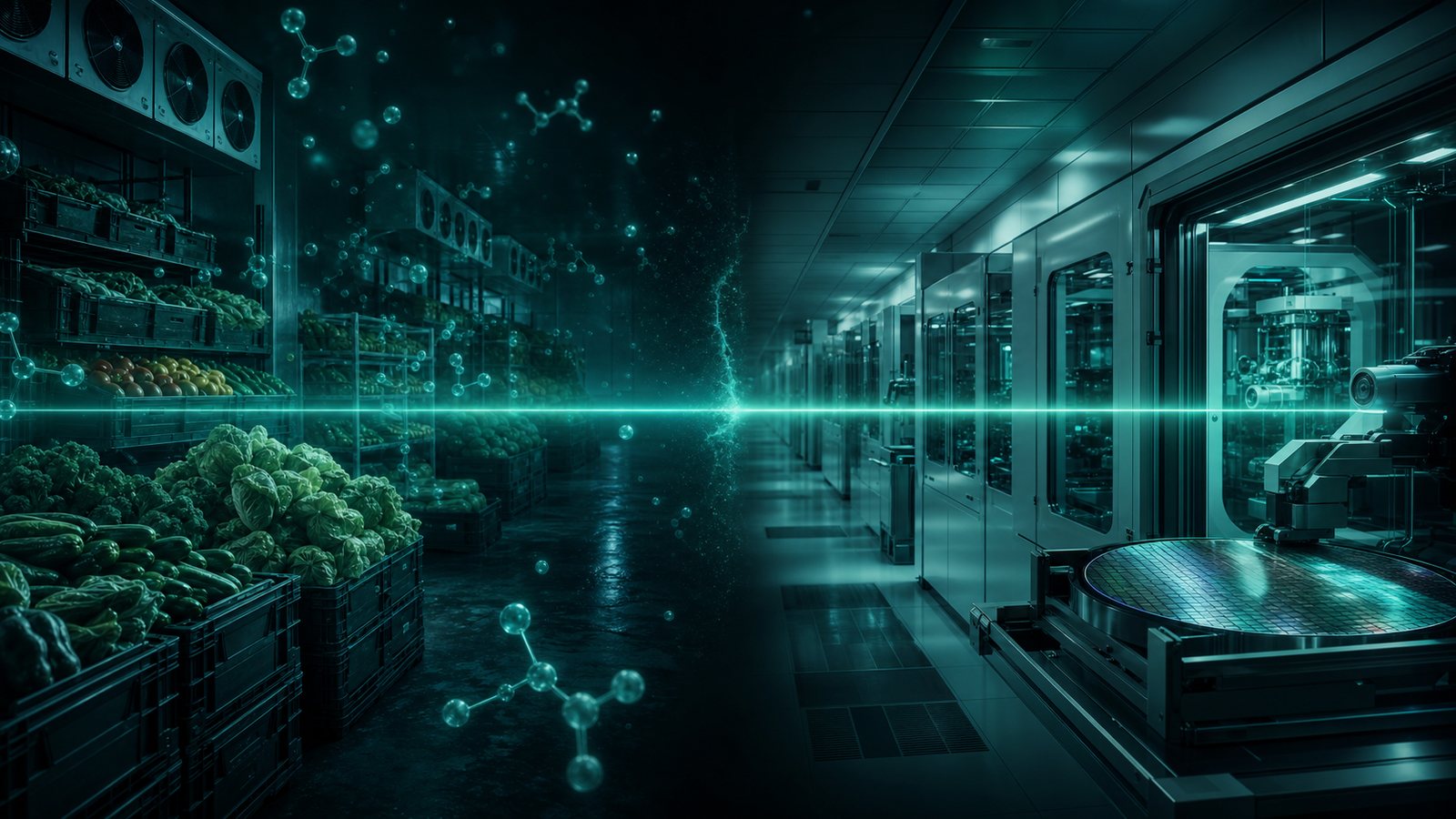
Every Moseley deployment runs the same four-stage pipeline. The chemistry, the targets and the actuators change with the application; the architecture does not. That is what makes Moseley a platform rather than a single product.
01Molecular Recognition
Detect — molecular recognition at trace concentration
Moseley sensing begins with molecular recognition. Our biomimetic sensor arrays are inspired by the way living tissue detects gases such as ethylene — selective binding chemistry that responds to the target molecule at parts-per-billion levels, in the presence of confounding background gases, humidity and temperature swings. Arrays combine multiple recognition chemistries so the platform reads a molecular fingerprint, not a single channel.
Biomimetic arraysppb sensitivityCross-selectivityE-Array · E-Nose
02Predictive Models
Predict — where the environment is heading
Raw signal becomes foresight. Machine-learning models trained on Moseley sensor data turn the molecular fingerprint into a forecast: how fast ethylene is accumulating and when produce will tip into over-ripeness, or how a contaminant plume will evolve across a process tool. Prediction is what turns monitoring into intervention — you act before the damage, not after.
ML forecastingDegradation curvesEarly-warning thresholds
03Autonomous Intervention
Control — act on the molecular environment
Detection and prediction close the loop only when the platform can act. Moseley pairs sensing with intervention — distributed remediation that removes or modulates the target gas, and signalling to existing infrastructure (HVAC, scrubbers, dosing, abatement). In fresh produce this means holding ethylene below the ripening threshold; in manufacturing it means keeping a molecular contaminant below the process tolerance.
Distributed remediationE-MCP modulatorActuation signalling
04Fleet Intelligence
Orchestrate — across a fleet of environments
A single room is a node. The platform coordinates many of them — cool rooms, distribution centres, refrigerated containers and trailers, or a line of process tools — into one fleet view. Orchestration shares models across sites, ranks where to intervene first, and turns thousands of molecular readings into supply-chain-level decisions.
Fleet dashboardCross-site modelsCold-chain & fab telemetry