Release the ethylene-action payload exactly when and where the device decides it matters.
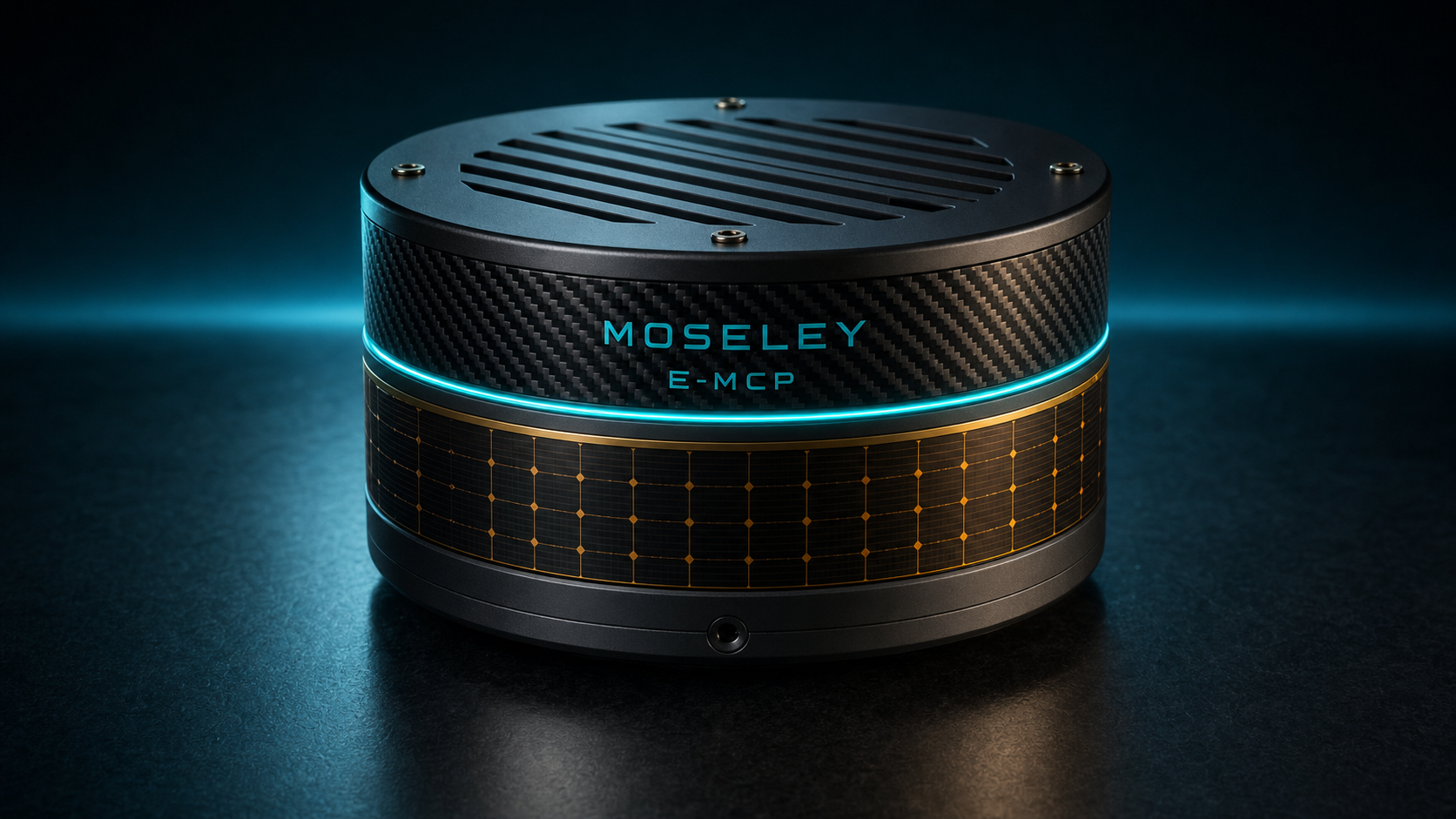
The Moseley E-MCP is a self-powered hockey-puck-sized device that sits on top of pallets inside refrigerated containers, cold rooms and ripening rooms. It holds an ethylene-action payload bound to a metal-organic-framework matrix, carries an on-board gated gravimetric sensing cavity to read its own headspace, and decides for itself when to release — or accepts orchestration commands from E-Aegis. Forty-two days of unattended operation.
▶ E-MCP explainer
▶ What is MCP?
DistributedSelf-sensingML-gated42-day floorAutonomous · or orchestratedBLE 5.3
E-MCP · ~80 mm diameter · flat battery pack + organic-PV sidewall · top louvre vent + rotating-disc shutter
01 · What it does
A distributed alternative to the single back-of-the-container modulator sachet.
Traditional climacteric-modulator delivery is a one-shot passive sachet or a centralised gas charge — fixed dose, fixed location, no awareness of where the ethylene-producing fruit actually is, no awareness of where the ripening hotspots have moved over time. The E-MCP is the opposite of that: a small autonomous release node, deployed in numbers across the cargo space, releasing payload only when the on-device or upstream model says it is warranted.
01 · Distribute
One node per pallet zone.
Pucks deploy on top of, or alongside, palletised cargo. Spatial coverage replaces the single back-wall dose so headspace concentration tracks the actual ripening front through the load.
02 · Decide
Release events are gated by on-device inference.
Each node runs an on-device TinyML model distilled from E-Array, E-Aegis and cloud teacher models. Release is triggered by the rate of change of ethylene seen by the puck's own gated sensing cavity — or by orchestration commands from E-Aegis when present. Never by absolute ppb thresholds.
03 · Release
MOF-bound payload, heated on demand.
The sealed cartridge holds the ethylene-action payload coordinated inside a metal-organic-framework matrix. A heating element beneath the cartridge liberates payload; a rotating-disc shutter and condensation-protected vent dispense vapour into the local headspace.
02a · Self-sensing
A sealed, periodically-gated sensing cavity inside the puck reads its own headspace.
The receptor chemistries that detect ethylene at trace levels — metal-organic frameworks functionalised with biomimetic ethylene receptors — cannot survive 42 days of continuous reefer humidity. The E-MCP solves this by placing the sensing material inside a sealed cavity that opens only briefly, on a configurable duty cycle. The receptor is protected for the majority of the deployment; ethylene is measured during short, controlled sampling windows.
A · Cavity
Sealed for most of the voyage.
A small chamber inside the housing carries a MOF functionalised with a biomimetic ethylene receptor. A gate or shutter seals it from the headspace between samples — no condensation, no humidity exposure, no receptor poisoning.
B · Sample
Open briefly, on a duty cycle.
Configurable intervals from one minute to 24 hours; exposure windows from one second to 30 minutes. During exposure, ethylene adsorbs onto the receptor and a gravimetric sensing element — typically a quartz crystal microbalance — measures the mass change.
C · Infer
Trajectory, not absolute ppb.
The on-device inference engine reads adsorption rate, acceleration and recovery profile across successive samples. It infers climacteric progression and emerging excursion conditions — then issues a release decision without any external controller required.
02b · Teacher → Student intelligence
Distillation, not measurement. The cheap puck inherits what the lab-grade instrument knows.
A laboratory-grade ethylene analyser — the kind that resolves single-digit parts-per-billion — is expensive, fragile and impractical to put on every pallet. The Moseley E-Aegis carries one of these instruments and uses it to learn what real climacteric events look like over thousands of cold-chain hours. That trained knowledge is then distilled into a TinyML model that runs on the E-MCP. The result: a hockey-puck-sized release node that infers climacteric progression with lab-grade decisioning, without carrying a lab-grade sensor.
A · What distillation means
A small model learns from a big one.
Distillation is a machine-learning technique in which a small, cheap model is trained to imitate the decisions of a large, expensive model. The big “teacher” learns from rich ground-truth data; the small “student” learns from the teacher’s outputs. The student ends up reproducing nearly the same decisions on commodity hardware.
B · The teacher
E-Aegis sees the truth.
The E-Aegis carries a ppb-accurate ethylene instrument and a multi-sensor array conditioned by E-Conditioning. It records real climacteric events under real cold-chain conditions and labels them — the kind of labelled dataset you can’t get from a spec sheet.
C · The student
E-MCP knows without measuring.
The distilled TinyML model is flashed onto every E-MCP. The puck doesn’t need a ppb-accurate sensor of its own — its gated gravimetric cavity gives it just enough signal, and the inherited model fills in the rest. Lab-grade decisioning at sticker-pack economics.
This is the core economic argument for distributed climacteric control: you only need to pay for the expensive instrument once — at the E-Aegis layer — and that intelligence then cascades to every E-MCP node in the fleet.
02 · What is inside
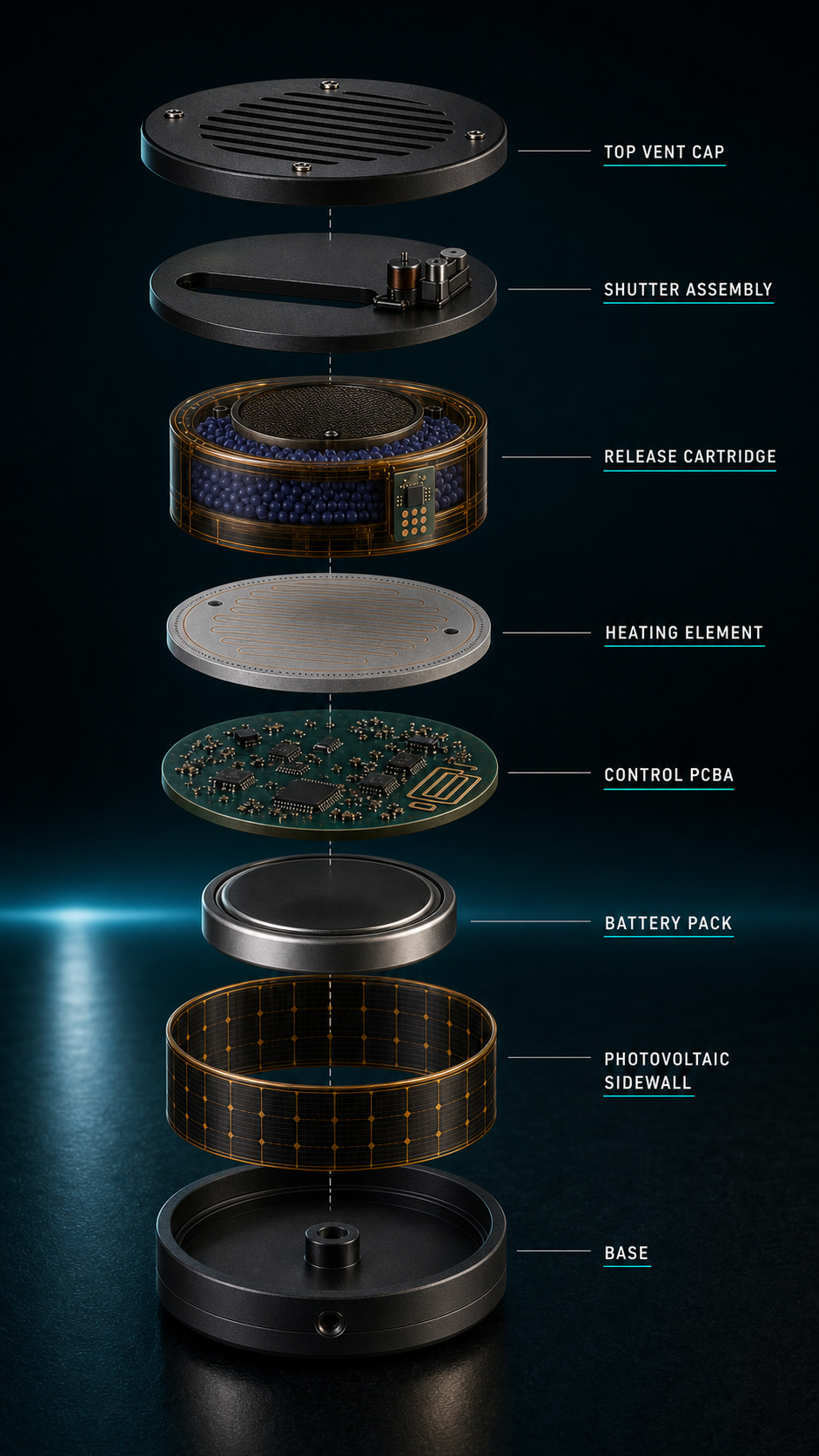
A nine-layer stack, every layer chosen to survive a 42-day reefer journey.
From top to bottom: a louvred vent cap protects the airway. A rotating-disc shutter inside a sealed chamber gates vapour egress and isolates the cartridge from condensation through a hydrophobic membrane and condensation trap. The release cartridge holds the ethylene-action payload bound to a metal-organic-framework matrix. A planar heating element beneath the cartridge drives controlled release. The control PCBA carries BLE 5.3, NFC cartridge identity and the on-device inference model. A flat battery pack of puck diameter provides primary energy; an organic-photovoltaic sidewall augments it for the 42-day operational floor. A base seals the assembly.
The E-MCP is the actuator arm of the Moseley Climacteric architecture.
The architecture is detect → predict → remediate. The E-Nose Label and E-Aegis sit on the detection side. The E-Sentinel ML model and the Metal-Cystine Sensor Array sit on the prediction side. The E-MCP — alongside the E-Remediation layer of the E-Aegis — sits on the remediation side, but as a distributed, networked actuator rather than a single bed inside the sentinel device.
Detect
E-Nose Label · E-Aegis E-Array. Per-carton labels and the sentinel device read ethylene and accompanying VOCs across the cargo space.
↓
Predict
E-Sentinel ML. A teacher-student TinyML model classifies the climacteric state — Baseline → Early → Confirmed → Critical — from the rate of change of ethylene, fused with humidity, CO₂ and temperature signals.
↓
Remediate
E-MCP nodes — distributed actuators with on-board sensing. Pucks self-sense via their gated gravimetric cavity and self-decide release, or accept E-Aegis orchestration that coordinates release events across the load. Release timing, dose and node selection are all functions of predicted climacteric progression — never raw ppb.
↓
Closed loop
Post-release, the sensing network observes the headspace response. The model updates its forecast and re-gates the next release. The platform logs every event for chain-of-custody and dose verification upstream via gateway to the Moseley cloud.
04 · In the field
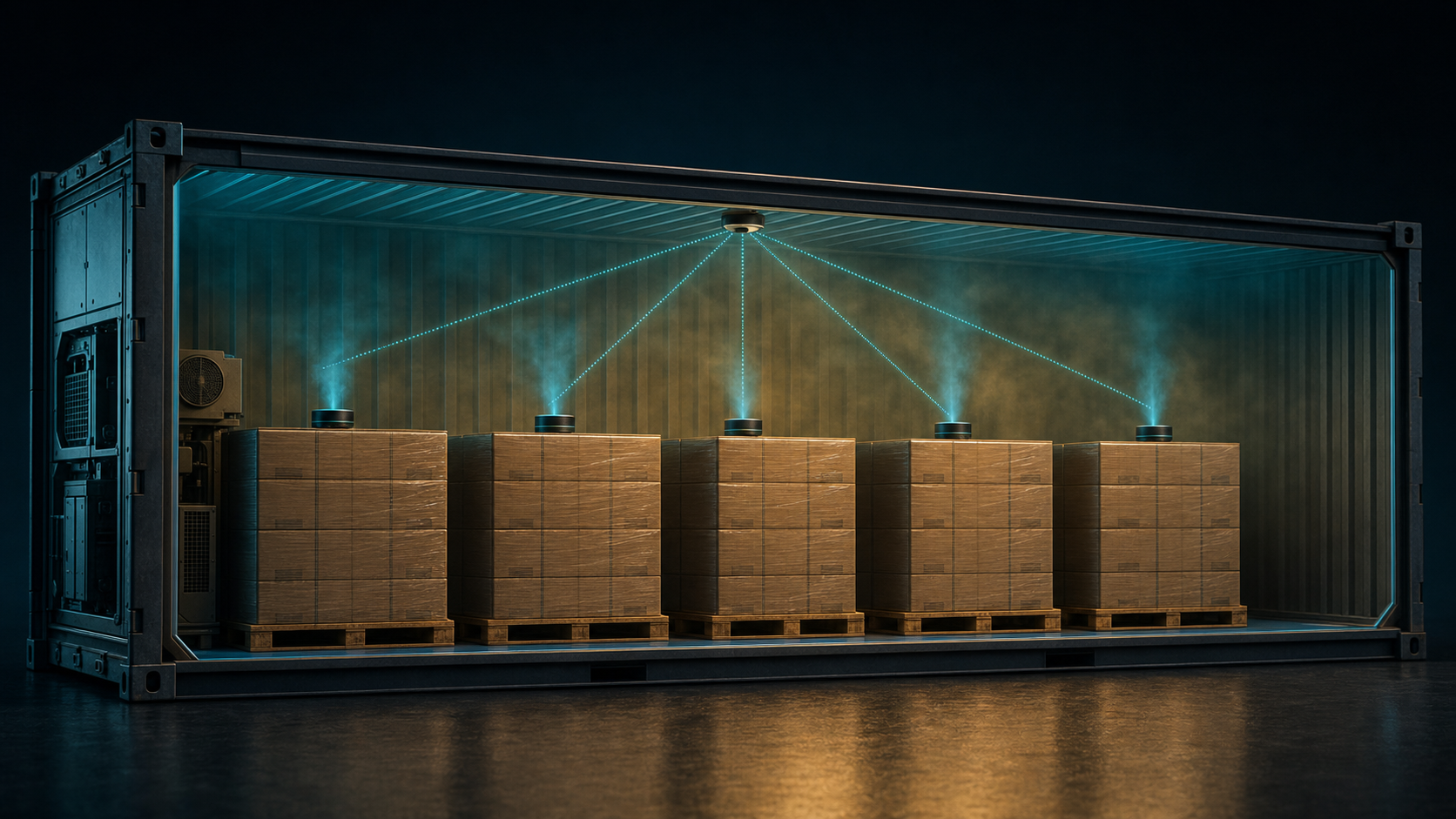
A reefer container loaded with palletised cargo, instrumented end-to-end.
A typical 40′ reefer carries several E-MCP nodes on top of the pallet stacks, an E-Aegis sentinel at the front bulkhead near the reefer return-air path, and per-carton E-Nose Labels in high-value cartons. Reefer return-air carries each puck's controlled vapour egress through the headspace; release events are coordinated so dose is delivered to identified ripening hotspots rather than the load as a whole.
Distributed E-MCP nodes in a reefer container · orchestrated under E-Aegis · vapour egress dispersed into the return-air path
01
One node per pallet zone
Nodes deploy on top of palletised cargo. Spatial coverage replaces a single fixed-dose source.
02
E-Aegis at the bulkhead
The sentinel device coordinates release events and bridges the BLE mesh to the upstream gateway.
03
Reefer-airflow coupling
Each node's vapour egress is entrained into the container's return-air path so dose reaches the hotspots that matter.
04
Closed-loop verification
The sensing network logs the headspace response after every release and updates the forecast for the next event.
Plan a distributed-remediation deployment.
Reefer container fleets, ripening-room operators and high-value DC managers — we are partnering with cold-chain operators on instrumented trials of the full Moseley Climacteric architecture, of which the E-MCP is the actuator layer.