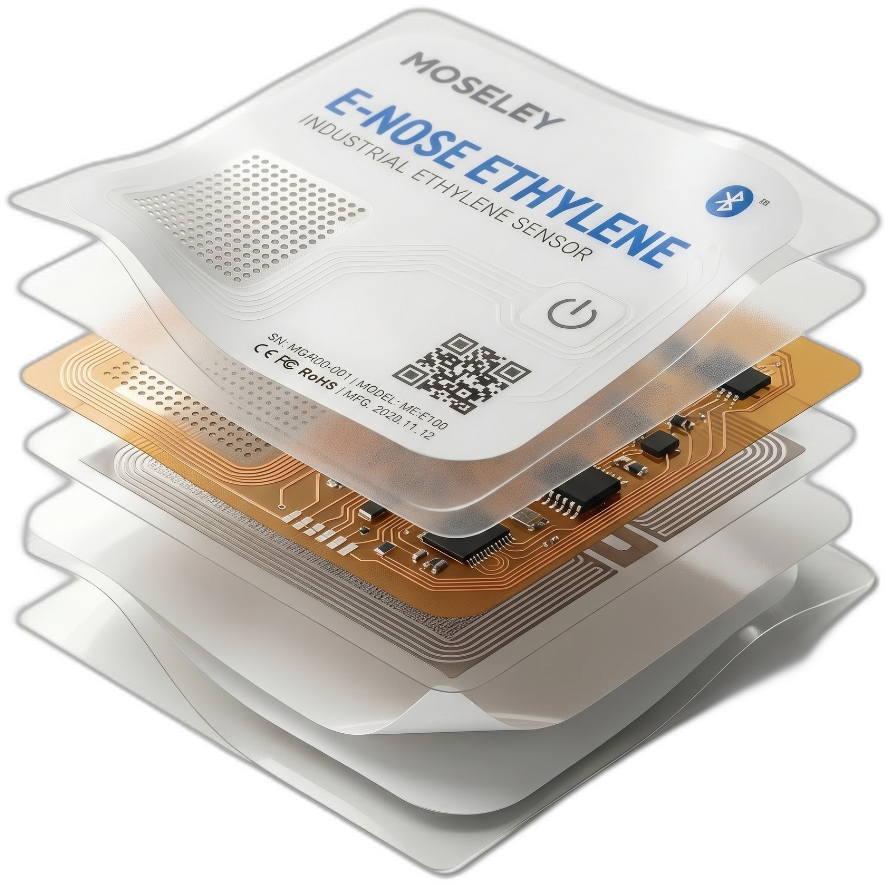
The Moseley Climacteric™ platform combines biomimetic ethylene sensing, distributed biological telemetry, predictive machine learning, and environmental orchestration to monitor how produce is biologically changing in real time.
We do not simply monitor the environment around produce. We measure how the produce itself is biologically responding to that environment.
Through distributed E-Nose sensing, E-Aegis orchestration, and E-Sentinel predictive intelligence, the platform is designed to detect ripening acceleration, ethylene-response behaviour, spoilage trajectory, and environmental stress across the cold chain. The result is a new class of infrastructure-free biological intelligence platform for fresh produce environments.
Moseley Climacteric™ is an integrated biological intelligence platform for fresh produce environments, combining distributed sensing, predictive machine learning, and active environmental remediation within a single closed-loop architecture.
The platform is designed to detect, interpret, and respond to produce respiration and ethylene-response behaviour in real time — from pallet-level biological sensing through to cloud-based trajectory prediction and in-environment remediation.
Three layers. Eight components. One continuous intelligence loop — from the first detectable biological change within a shipment to predictive spoilage analysis and active environmental intervention before product quality is lost.
New to ethylene? Start here · 4:41
A plain-language introduction — no chemistry assumed. Learn what ethylene is, the role it plays in ripening fresh produce, and how researchers at Henan Agricultural University built a biomimetic copy of the plant's own ethylene receptor — then turned that molecular capture into a measurable signal that powers the Moseley Climacteric platform.
Watch · 3:48
A narrated overview of the platform architecture — from biomimetic ethylene sensing and distributed E-Nose telemetry, through predictive ML trajectory modelling, to coordinated remediation across reefers, cool rooms, distribution centres, and retail environments.
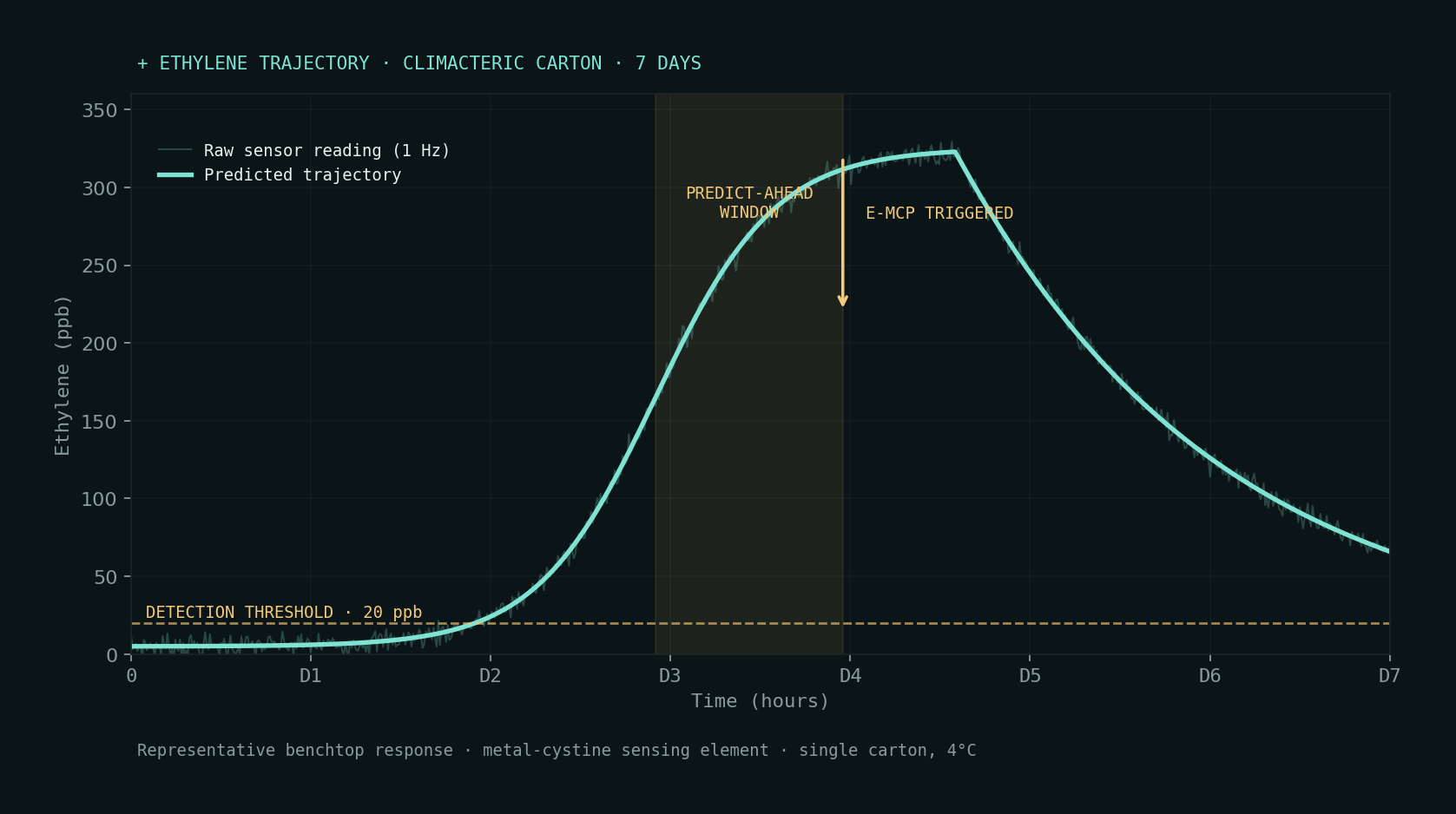
Reading the chart · Ethylene trajectory over 7 days
This chart shows what Moseley sees inside one climacteric carton over a seven-day cold-chain window. The y-axis is ethylene concentration in parts-per-billion (ppb); the x-axis is time in days. The faint trace is the raw 1 Hz sensor reading from the metal-cystine sensing element at 4 °C. The bold cyan line is the predicted ripening trajectory generated by the on-device E-Sentinel model — a forward-looking forecast, not just a measurement.
Three moments matter. The detection threshold (~20 ppb, dashed line) is when the platform first calls a biological event. The predict-ahead window (highlighted) is where the model says “this carton will tip into accelerated ripening within the next few hours.” The E-MCP trigger (arrow) is the moment the active remediation node is dosed — ahead of the curve, not after the damage. The downslope that follows is the ethylene decay once the MOF canister is pulling gas out of the airspace.
Sensor sits below the 20 ppb detection threshold. Produce is metabolically quiet — the platform is listening, but there is nothing to act on yet.
Ethylene begins to accumulate as autocatalytic ripening kicks in. The raw signal climbs above threshold and the trajectory model locks on to a rising curve.
E-Sentinel forecasts the carton will exceed the spoilage envelope inside the next forecast horizon. The platform calls for active intervention before peak ethylene, not after.
The MOF canister is dosed into the airspace. Ethylene falls from ~320 ppb back toward ~60 ppb over three days — the curve the buyer never sees, because the fruit holds its quality.
Reading the diagram · System architecture
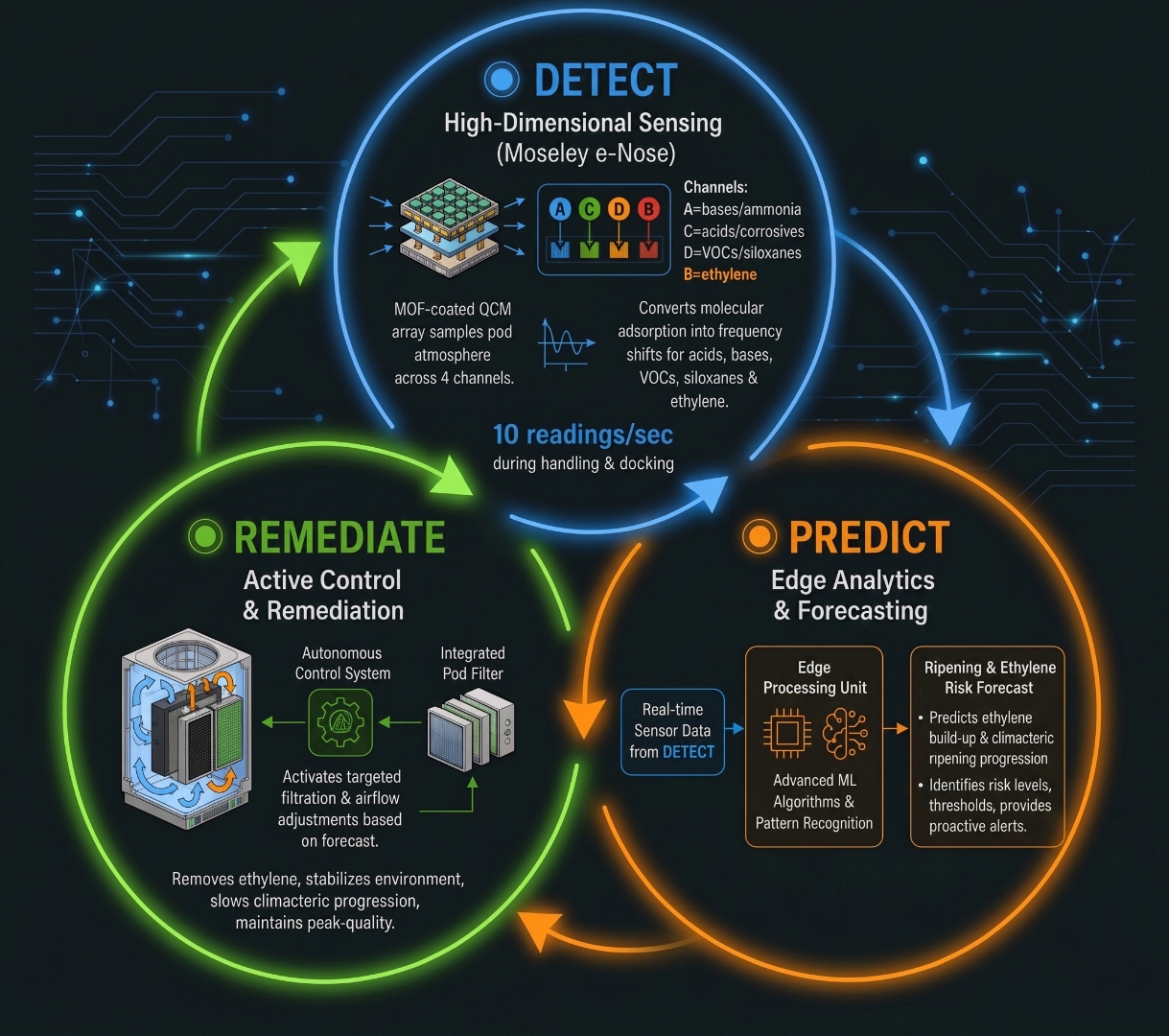
Moseley Climacteric is built as three horizontal lanes that flow left-to-right and converge on a single cloud hub. Detect at the top is the sensing layer that lives with the produce. Predict in the middle is the machine-learning layer that turns raw signal into a ripening forecast. Remediate at the bottom is the actuation layer that physically removes ethylene from the airspace. All three lanes feed the E-Platform cloud, which fuses the data, drives operator dashboards and APIs, and closes the loop back to remediation with a single autonomous control signal.
Read the diagram as a journey: a pallet of produce passes a sticker-class E-Nose Label as it moves through the cold chain; the host E-Aegis platform aggregates that telemetry; the E-Sentinel TinyML model running on-device computes a calibrated risk score; the E-Platform cloud orchestrates a fleet of these nodes and — when risk crosses threshold — triggers an E-Remediation canister to act in the same airspace as the fruit. No human in the loop, no shipment-level guesswork.
Biomimetic ethylene sensing at the pallet. E-Nose Pallet Label is a sticker-class sensor; E-MCP is the release node; E-Aegis is the host platform that runs them. This is what lives with the fruit.
E-Sentinel is the on-device TinyML model. It turns raw sensor readings into a ripening trajectory and a calibrated risk score — so the system acts on forecast, not lag.
E-Remediation is the MOF-based ethylene-removal canister. When the risk score crosses threshold, the canister is dosed into the same airspace as the produce — holding ethylene below the ripening envelope.
All three lanes converge on the cloud. The platform fuses fleet telemetry, drives operator dashboards, alerts and APIs, and — critically — sends the autonomous control signal back to remediation. That arrow back is what makes it a loop, not a dashboard.
The sensing layer does not chase an absolute ethylene concentration — it watches for the rise. A biomimetic chemistry stack built on Cu / Fe / Zn / Co / Ni / Mn metal-cystine coordination motifs responds to small, early increases in ethylene against a stable baseline of other ripening volatiles. Water-vapour drift is compensated; an ethylene-selective filter layer narrows the response. The output is a trend signal — exactly the input the trajectory model needs.
An ML model runs first on the sensor board and again in the cloud, consuming the change signal from the array and fusing it with the other volatile channels into a ripening trajectory and a remaining shelf-life estimate. The biomimetic chemistry layer cross-validates ethylene specificity through multiple metal-cystine coordination motifs in parallel.
When the predicted ethylene trajectory crosses a threshold, a multi-bed adsorbent scrubber is gated on by the trajectory model. Remediation happens in the same airspace as the fruit, with no operator intervention — a closed loop from sensing to actuation.
The platform ingests every sensor stream across the fleet, runs cloud-side fusion against a reference instrument set, drives operator dashboards and alerts, and pushes model updates and gating thresholds back to the edge. Without the platform there is no fleet — only isolated nodes.
“Climacteric” is the botany term for the post-harvest ripening burst triggered by ethylene. The product name takes that biological reality as its starting point.
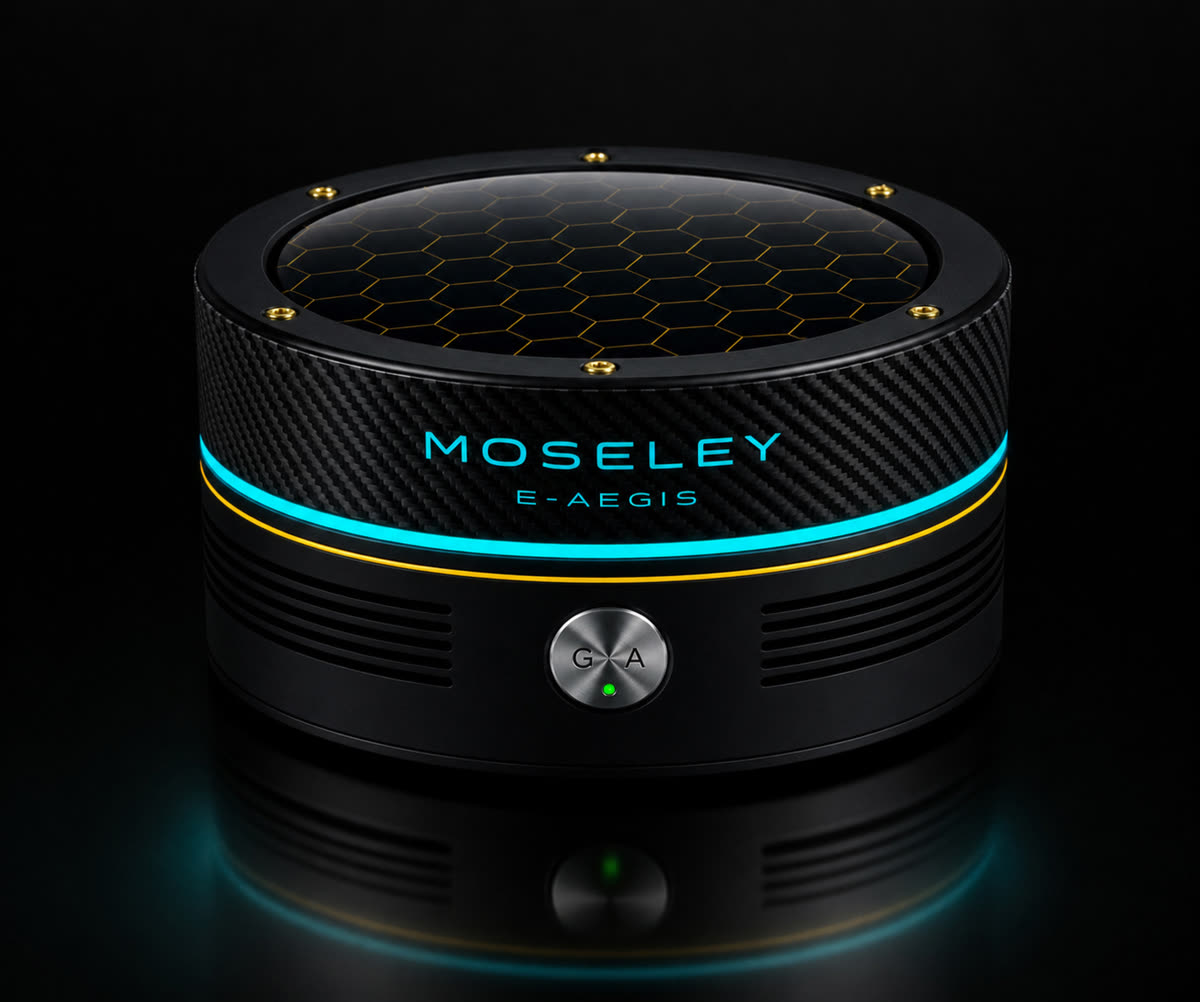
The Moseley E-Aegis is a single self-powered device that draws an air sample, conditions it, senses ethylene and accompanying contaminants down to the parts-per-billion range, decides what to do about it, and remediates — all on board, all under machine-learning gating. Internally it is built as three independent layers — E-Conditioning, E-Array and E-Remediation — each of which can be modified or substituted to suit the environment (cool room, refrigerated trailer, sea container, distribution centre).
A single ambient-energy-augmented unit that lives inside the cargo space for the whole journey. An inlet draws a sample. The conditioning stack strips interferents. The sensing array reports ethylene and related VOC trajectories. The on-device machine-learning model decides when to gate the remediation stack. The unit transmits a verified trajectory upstream to the Moseley cloud and operates for not less than 42 days without external charging. The three layers below are independent — each can be modified, swapped, or tuned to suit the deployment.
The E-Aegis is built as three independent layers that work as one device — each tunable for the deployment without redesigning the others.
Multi-stage sample preparation — filter, desiccate, O₂ scrub, S guard — tuned per environment before any sensing happens.
Metal-cystine sensing array with ML fusion — turns a multi-channel response into a single confidence-scored ethylene trajectory.
Sentinel-gated multi-bed receptor-in-host capture — beds engage only when the model warrants it, conserving sorbent life.
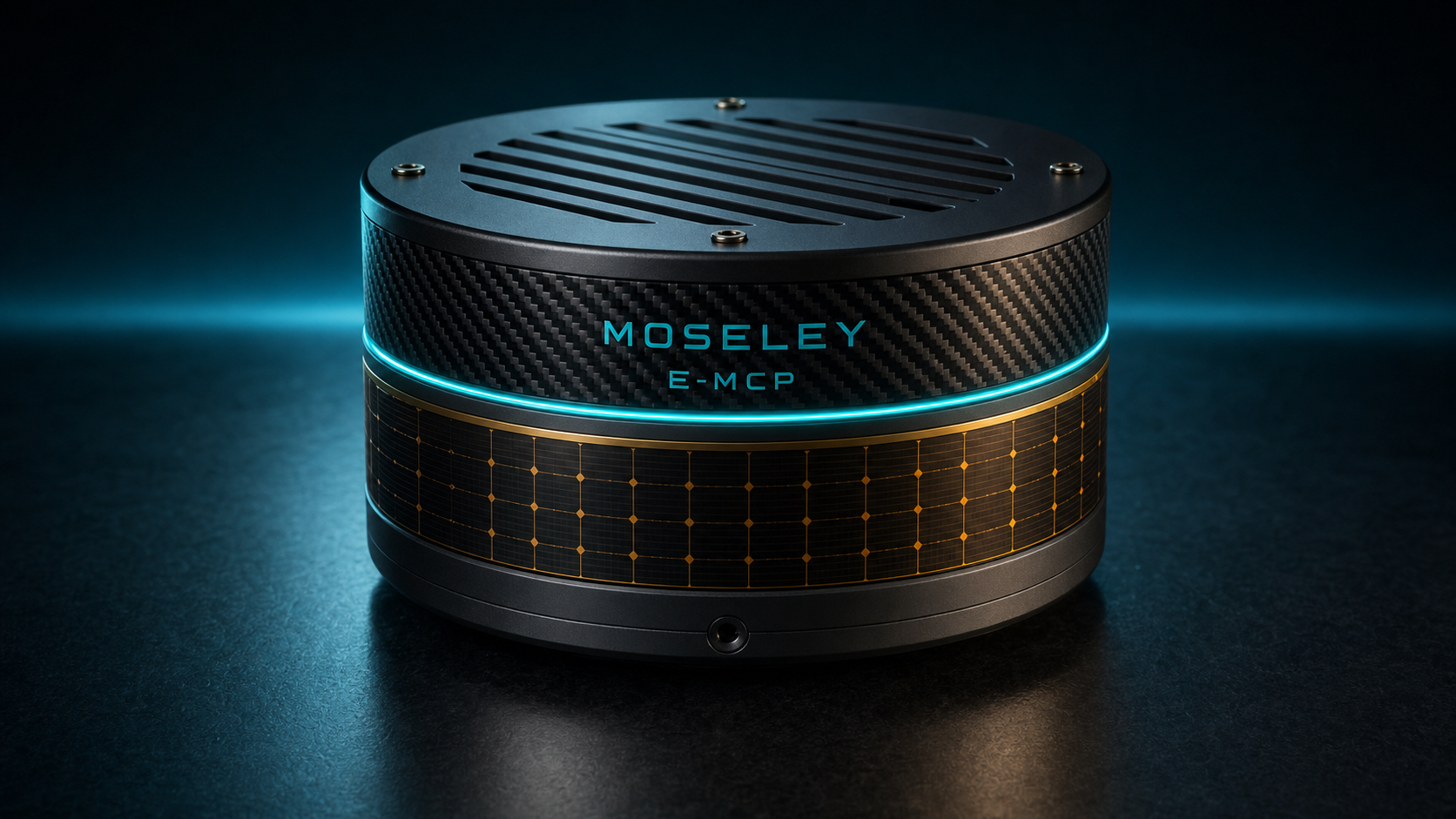
The E-MCP is a self-powered hockey-puck-sized release node that sits on top of pallets inside refrigerated containers, cold rooms and ripening rooms. A sealed cartridge holds an ethylene-action payload bound to a metal-organic-framework matrix; a heater beneath the cartridge releases payload on demand, a rotating-disc shutter and condensation-protected vent dispense vapour into the headspace, and a flat battery pack augmented by an organic-photovoltaic sidewall delivers a 42‑day operational floor. A sealed, periodically-gated sensing cavity — carrying a MOF + biomimetic ethylene receptor and a gravimetric sensing element such as a quartz crystal microbalance — lets the puck read its own headspace on a duty cycle and self-trigger release through on-device TinyML inference. Nodes operate autonomously or under E-Aegis orchestration, with release events gated by predicted climacteric progression — never raw ppb.
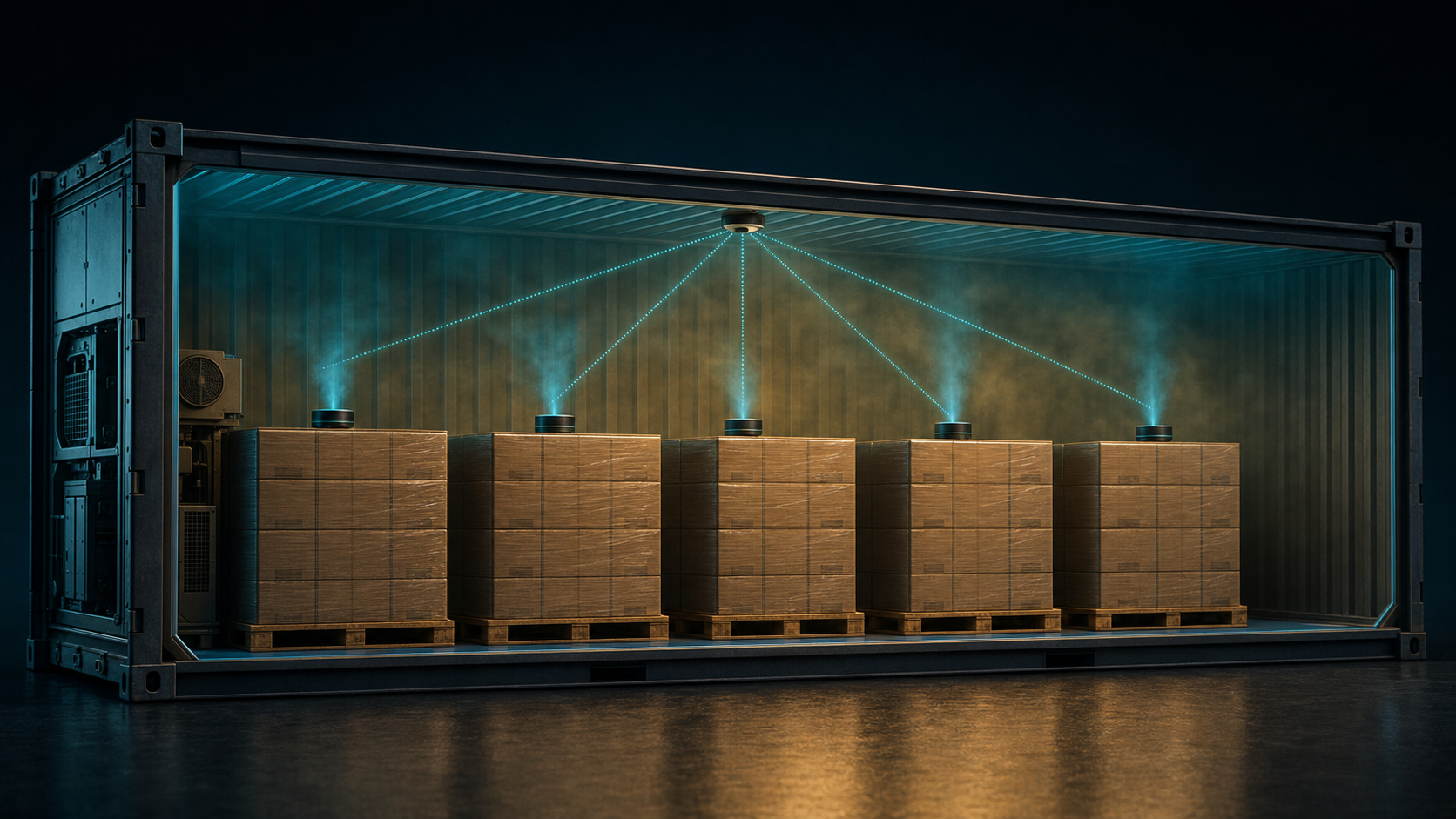
Several E-MCP nodes sit on top of the pallet stacks. An E-Aegis sentinel at the front bulkhead coordinates release events across the load. Reefer return-air carries each puck’s controlled vapour egress through the headspace so dose is delivered to identified ripening hotspots rather than the load as a whole.
An ultra-thin intelligent sensing patch designed to continuously monitor ethylene-response behaviour and produce headspace conditions throughout the cold chain. Attach directly to cartons or pallets and the platform captures biological telemetry across the entire journey using infrastructure-free opportunistic communications.
A TinyML inference engine running on the same PCBA as the E-Nose Label and inside the E-Canister. It classifies climacteric state — Baseline → Early → Confirmed → Critical — from the rate of change of ethylene emission measured across a metal-cystine sensor array, fused with humidity, CO₂ and temperature signals. No cloud round-trip required. Models update over the air via the fleet-learning loop.
Biomimetic metal-cystine coordination complexes paired with selective metal-organic frameworks — a Nobel-recognised materials class. The sensing chemistry inside the E-Array and the active capture chemistry inside E-Remediation share the same family. The same materials that detect ethylene in ppb are what capture and hold it.
Direct ethylene sensing on a multi-element metal-cystine array with on-array fusion of humidity, CO₂ and temperature. Edge ML tracks the rate of change of emission and predicts the climacteric trajectory before classical concentration thresholds trigger — the difference between detecting ripening and intervening before it cascades.
Letter of intent from AgroFresh, a global leader in post-harvest produce solutions, to purchase upon successful technical proof. Pilot pathway is in place; commercial pull-through is contingent on field validation.
9 Australian provisional patents filed covering sensing, prediction and active remediation. PCT deadline April 2027. All patents held by Ambient IoT Pty Ltd, sole inventor Tony Raftis.
While initial development is focused on climacteric fresh produce, the Moseley architecture may also apply to other ethylene-sensitive environments including cut flowers, greenhouses, seed storage and post-harvest storage systems.
Secondary and future applications. Fresh produce remains the current commercial focus.
See how detection, prediction and remediation come together in the visualization and decision layer — biological-state scoring, ethylene risk, remaining marketable life and remediation priority across the cold chain.