Read what is happening inside the fruit, in real time, from a battery-free sticker.
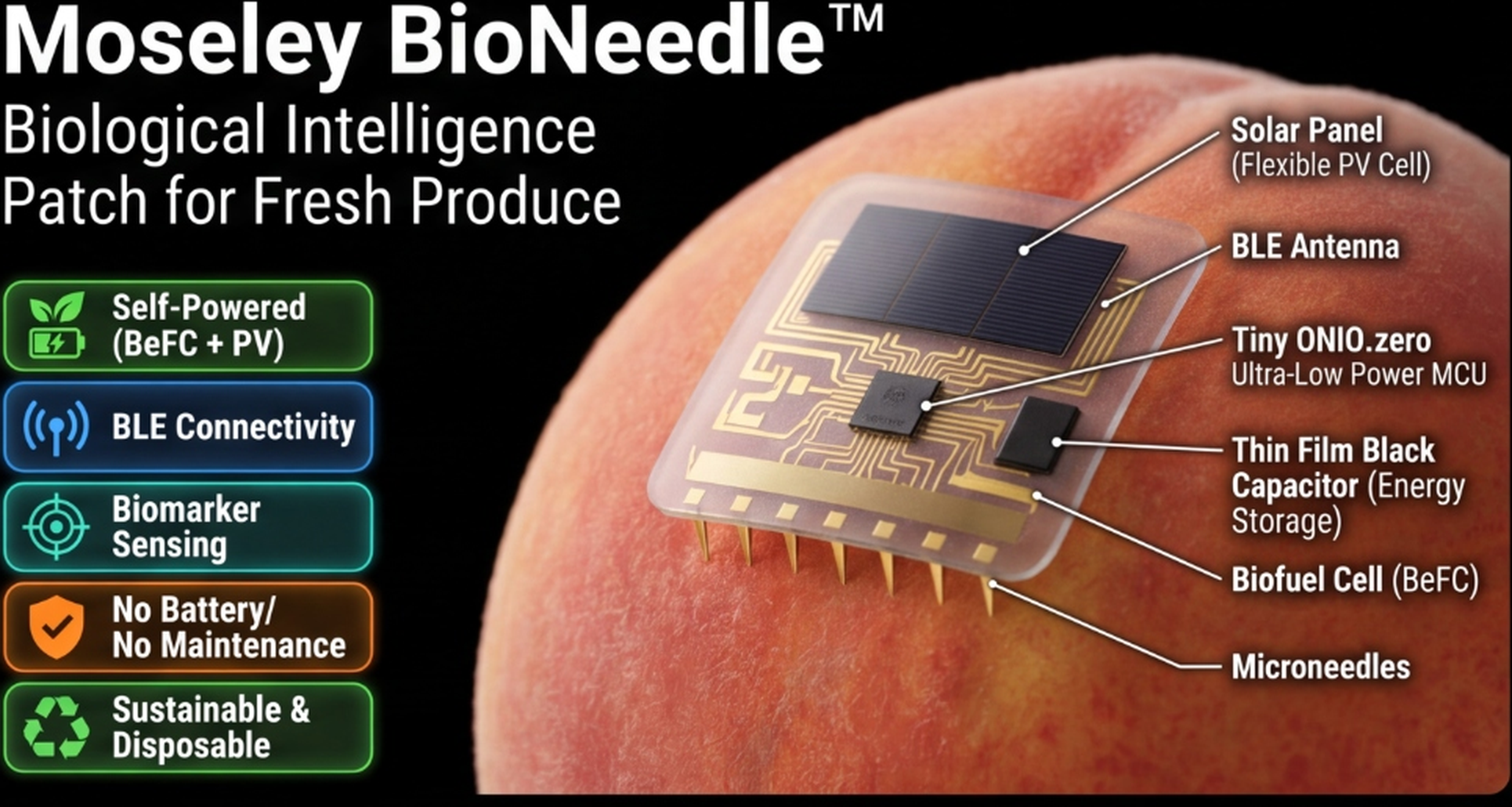
The Moseley BioNeedle moves the sensing interface off the surrounding air and into the produce itself. A sub-millimetre microneedle array slips past the cuticle into the soft tissue, where biomimetic receptors read two ripening hormones at their source — abscisic acid (ABA), the early stress-and-readiness signal that rises before any visible change, and ethylene, the classical ripening gas. The proposed label is self-powered by a hybrid fruit-sap biofuel cell and indoor photovoltaic, runs an ultra-low-power energy-harvesting ASIC, and reports over Bluetooth Low Energy. No battery. No maintenance. Disposable.
BioNeedle · flexible biopolymer label · sub-mm microneedle array · hybrid biofuel + PV power · ONiO.zero MCU + BLE
01 · What it does
Reading fruit from the inside — biology at the source, not chemistry at the headspace.
Conventional ethylene sensing sniffs the gas after it has diffused out of the fruit and into the surrounding atmosphere, where the reading is blurred by airflow, dilution, ventilation, humidity, neighbouring fruit and atmospheric mixing — every one of those a source of environmental noise the system has to correct away before it can say anything about the produce. The BioNeedle moves the sensing interface into the fruit itself. A sub-millimetre microneedle array slips past the cuticle into the soft tissue, intercellular fluid and vascular sap — the chemical environment the plant actually uses to signal — and measures the biological process closer to its source.
Measuring both hormones in the same place gives a richer picture than external telemetry alone: ABA rises early, before visible change and before ethylene, so it signals that ripening is about to start; ethylene confirms ripening has started. Each layer of this architecture — needle access, biomimetic recognition, 2D-material electrodes and battery-free smart-label electronics — has been independently proven in published work. The integrated dual-hormone in-fruit label is the proposed, under-development platform Moseley is building and filing as patentable IP.
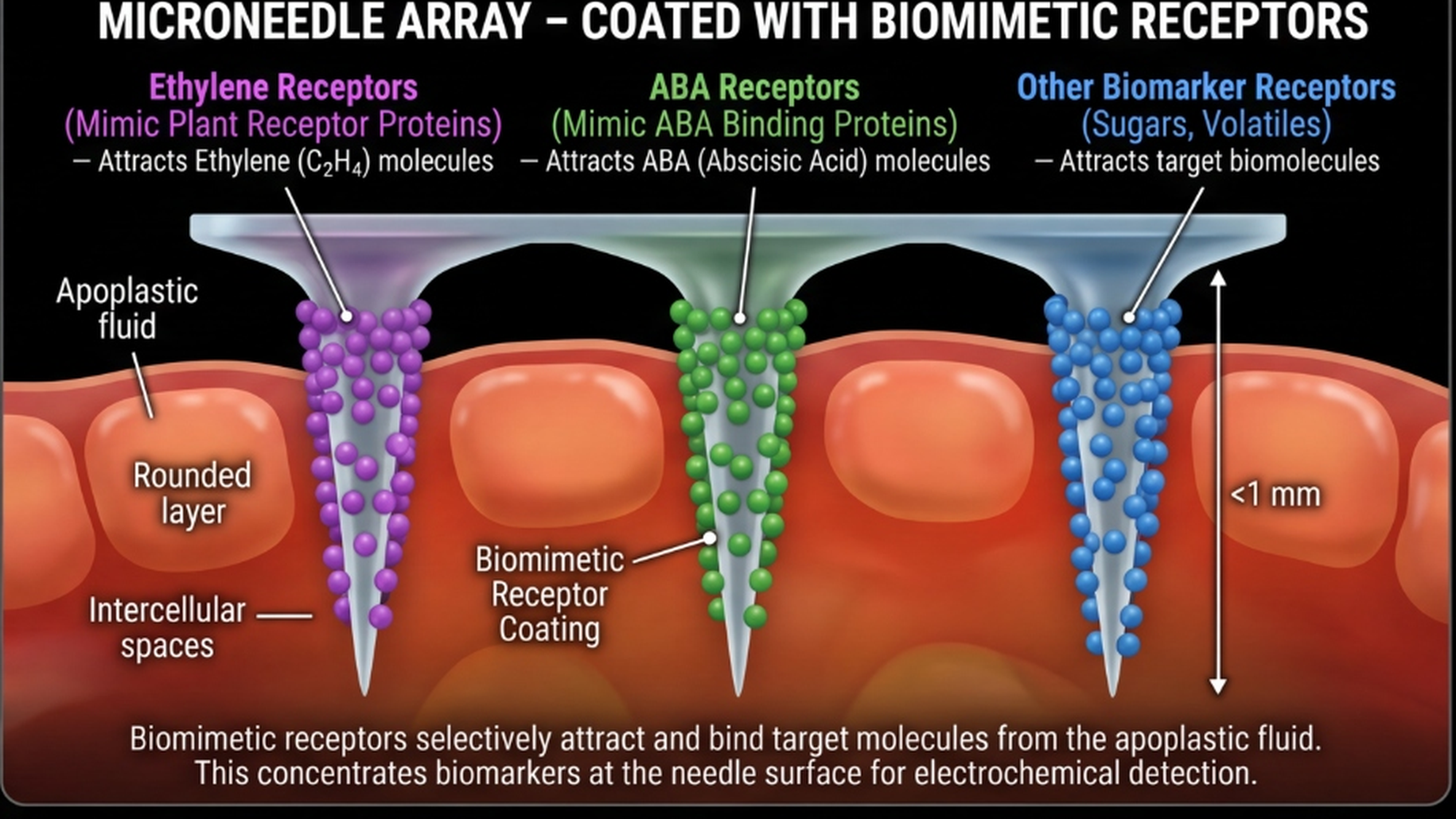
Microneedle array · biomimetic receptors selectively attract and bind their target molecules from the apoplastic fluid
01 · Microneedle access
100–1000 µm needles, painless to the fruit.
Each needle is between 100 and 1000 micrometres long — on the scale of a human hair. The array bypasses the waxy cuticle that blocks surface sensors and reaches the interstitial fluid and vascular sap beneath, stopping short of the deep tissue that would trigger a wound response. The fruit treats it like minor insect feeding and reseals within hours.
02 · Dual-hormone detection
Each needle is selective for one hormone.
Needles are coated with biomimetic receptors that mimic the plant’s own recognition chemistry — aptamer or antibody layers on gold-coated needles for ABA, and a biomimetic copper-cystine / MXene receptor, inspired by the plant’s own ethylene receptor, for ethylene. Selectivity is built into the chemistry, not the algorithm.
03 · Continuous readout
Electrochemical sensing on a single die.
Bound biomolecules shift the local charge environment at the needle tip. A small ASIC reads the change in current and voltage, runs the signal through an on-die analog front-end, and ships a calibrated reading to a phone, gateway or platform over BLE every few minutes.
02 · How it works
Five steps from skin contact to phone screen.
The BioNeedle pipeline mirrors the way the fruit itself uses these molecules — receptor binding inside the tissue, charge transfer at the membrane, signal amplification at the readout. The result is a continuous, calibrated stream of biomarker concentrations available to the produce supply chain in near real time.
01
Insertion
02
Biomimetic detection
03
Capture & concentration
04
Electrochemical detection
05
Data transmission
Process flow · from skin contact to phone screen in five stages
1 · Insertion
Patch is pressed onto fruit.
A light press seats the microneedle array through the cuticle and into the soft outer tissue, reaching the apoplastic fluid in seconds.
2 · Biomimetic detection
Receptors bind their target.
Ethylene receptors capture C₂H₄. ABA receptors capture abscisic acid. Other channels capture sugars and volatile acids. Each receptor sees its own molecule, and nothing else.
3 · Capture & concentration
Target molecules accumulate at the needle surface.
Receptor binding concentrates target molecules from the surrounding fluid onto the electrode surface — converting a dilute biological signal into a localised electrochemical signal strong enough to read cleanly.
4 · Electrochemical detection
Bound molecules shift current and voltage.
A reference and counter electrode complete the circuit. Bound biomarker concentration is translated into a measurable change in current and voltage at the working electrode — read by the on-board ASIC.
5 · Data transmission
Calibrated readings stream over BLE.
The microcontroller logs each reading on-board, then broadcasts the accumulated payload over Bluetooth Low Energy — or by backscatter when power is scarce — to a phone, gateway or the Moseley platform: ethylene, ABA and the reference, pH and temperature channels that correct them, all from a single label.
03 · Hybrid self-powered system
No battery. No maintenance. Energy harvested from the fruit and the room.
A label that needs charging is not a label — it is an instrument. The BioNeedle pairs a paper-based biofuel cell that runs on sugars in the fruit sap with a printed indoor photovoltaic, buffers the combined harvest in a thin-film capacitor, and runs all of it through a single-die ONiO.zero RISC-V microcontroller with on-die power management and BLE. The result is a label that can be applied at the pack-house and forgotten until it arrives on the shelf.
A · Biofuel cell
Paper BoFC powered by fruit sap.
A printed bioenzymatic fuel cell uses FAD-glucose dehydrogenase to oxidise free glucose in apoplastic fluid wicked up through the needles. Roughly 3 mW peak and ~150 µA continuous at 0.7 V — comfortably above the label’s active budget.
B · PV light assist
Printed indoor photovoltaic.
An organic photovoltaic cell printed onto the back of the patch harvests indoor LED and fluorescent light down to 200 lux. Roughly 550 µW continuous from a 25 cm² panel — the primary source during transit and warehousing.
C · Energy storage
Thin-film capacitor.
A 500 µF to 8 mF supercapacitor buffers the harvest. Deep-sleep draw is below 1 µW; a full wake-and-measure cycle costs about 17 µJ, comfortably inside the stored energy budget.
D · Energy-harvesting ASIC
Sleep / wake, log, then transmit.
A single-die microcontroller with on-die power management, flash, the analogue front-end and a radio. It sleeps below 1 µW, wakes every few minutes to read and log the needles locally, and sends the stored payload by BLE when light is available — or by ambient-RF backscatter for fully battery-free links. If no power is available it simply logs and waits: store-and-forward.
04 · Cross-section of a single needle
Recognition chemistry on the outside. A four-electrode electrochemical cell on the inside.
Every needle is a complete sensor in its own right: a biomimetic recognition coating on the exterior, a working electrode beneath, and matched reference, counter and additional working electrodes integrated into the patch substrate. Multiplexing across needles lets a single patch read ethylene, ABA and additional biomarkers in parallel from the same tissue volume.
Needle baseFood-safe biopolymer microneedles, gold-coated to carry the recognition chemistry and connect it to the label electronics.
ABA channelAptamer or antibody recognition layer self-assembled onto the gold surface.
Ethylene channelBiomimetic copper-cystine receptor on a conductive 2D-material (MXene) electrode film.
Anti-foulingA biohydrogel molecular sieve passes small hormones while blocking proteins and cell debris, extending sensor life from hours to weeks.
CorrectionReference electrode plus dedicated pH and temperature channels correct the hormone signals for drift in real fruit sap.
BioSentinel label blueprint · the integration of these independently proven layers is the proposed, patentable platform
05 · How it integrates
From external telemetry to internal biological intelligence.
The Moseley architecture is detect → predict → remediate. StiknTrak supplies the external context — location, temperature, humidity and dwell — describing what is happening around the produce. The BioNeedle supplies the signal nothing else can: the hormone state inside the fruit. It sits at the deepest end of the detection layer as a source-of-truth biological signal and feeds E-Sentinel ML for climacteric prediction and the E-MCP for distributed remediation — turning earlier, more specific insight into proactive intervention before ripening or spoilage becomes loss.
Detect · inside the fruit
BioNeedle. Sub-millimetre microneedle patch on the produce surface. Biomimetic receptors for ethylene, ABA and additional biomarkers. Continuous readings over BLE. Self-powered. Disposable.
↓
Detect · around the fruit
E-Nose Label · E-Aegis E-Array. Per-carton labels and the sentinel device read ethylene and accompanying VOCs across the cargo space, complementing the inside-the-fruit readings from the BioNeedle.
↓
Context · external telemetry
StiknTrak. Location, temperature, humidity and dwell describe the environment the produce is travelling through — the external context against which the BioNeedle’s internal biological signal is interpreted.
↓
Predict
E-Sentinel ML. A teacher-student TinyML model fuses BioNeedle internal-hormone readings with headspace gas measurements to classify the climacteric state — Baseline → Early → Confirmed → Critical — earlier than either signal can alone.
↓
Remediate
E-MCP nodes. Distributed actuators release ethylene-action payload when, where and to the dose the predicted climacteric state requires — gated by the biological intelligence the BioNeedle and E-Sentinel ML produce upstream.
06 · Key features
What the BioNeedle delivers, summarised.
✓
Microneedle access to internal fruit biology
Reaches the apoplastic fluid where ripening hormones actually live — not just the gas that eventually escapes.
✓
Biomimetic receptors for highly selective detection
Recognition chemistry mimics the plant’s own receptor proteins — selectivity is built into the molecule, not inferred by the algorithm.
✓
Real-time monitoring of ethylene, ABA and other key biomarkers
Multiplexed channels return concentration readings every few minutes — not days later from a lab.
✓
Self-powered — no batteries, no maintenance
Hybrid biofuel cell + indoor PV. Buffered through a thin-film capacitor. Operates unattended for the entire produce voyage.
✓
Sustainable & disposable
Paper-based biofuel cell, biopolymer substrate, no metal battery. Designed to be applied at the pack-house and discarded at the shelf.
✓
Enables true biological intelligence of fresh produce
For the first time, the supply chain can read what the produce itself is doing — not what the air around it is doing.
Restricted access — partner programme only.
The BioNeedle is pre-release. We are partnering with selected fresh-produce growers, packers and supply-chain operators on instrumented field trials, and with selected research and IP partners on the underlying receptor chemistry. To request access, please get in touch.