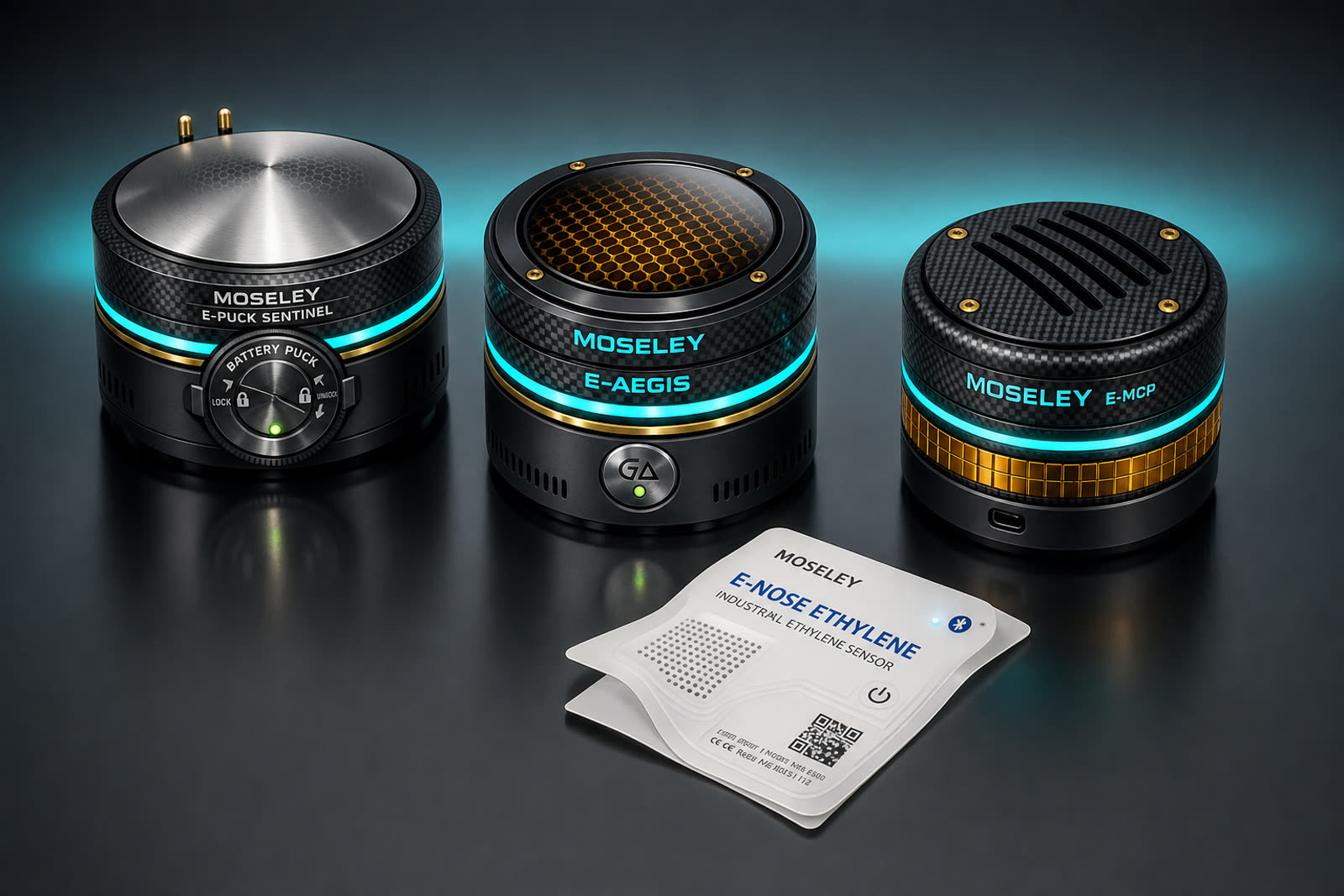
E-Array, E-Nose, E-Aegis and E-MCP are the technology components of the Moseley Predictive Molecular Intelligence platform — not standalone products. The E-Aegis is a single self-powered detect-decide-control unit built from three independent layers (E-Conditioning, E-Array and E-Remediation), each modifiable to suit the deployment, while the E-Nose adds in-box molecular history for high-value cartons.
Detect ethylene, predict ripening, remediate — across the full cold chain.
The Moseley Climacteric Platform is modular. Each component — the E-Aegis, the E-MCP and the E-Nose Label — operates autonomously, and integration is optional. Deploy across containers, reefer trailers, cool rooms, distribution centres and retail.
Predictive Environmental Sensing and Autonomous Remediation System.
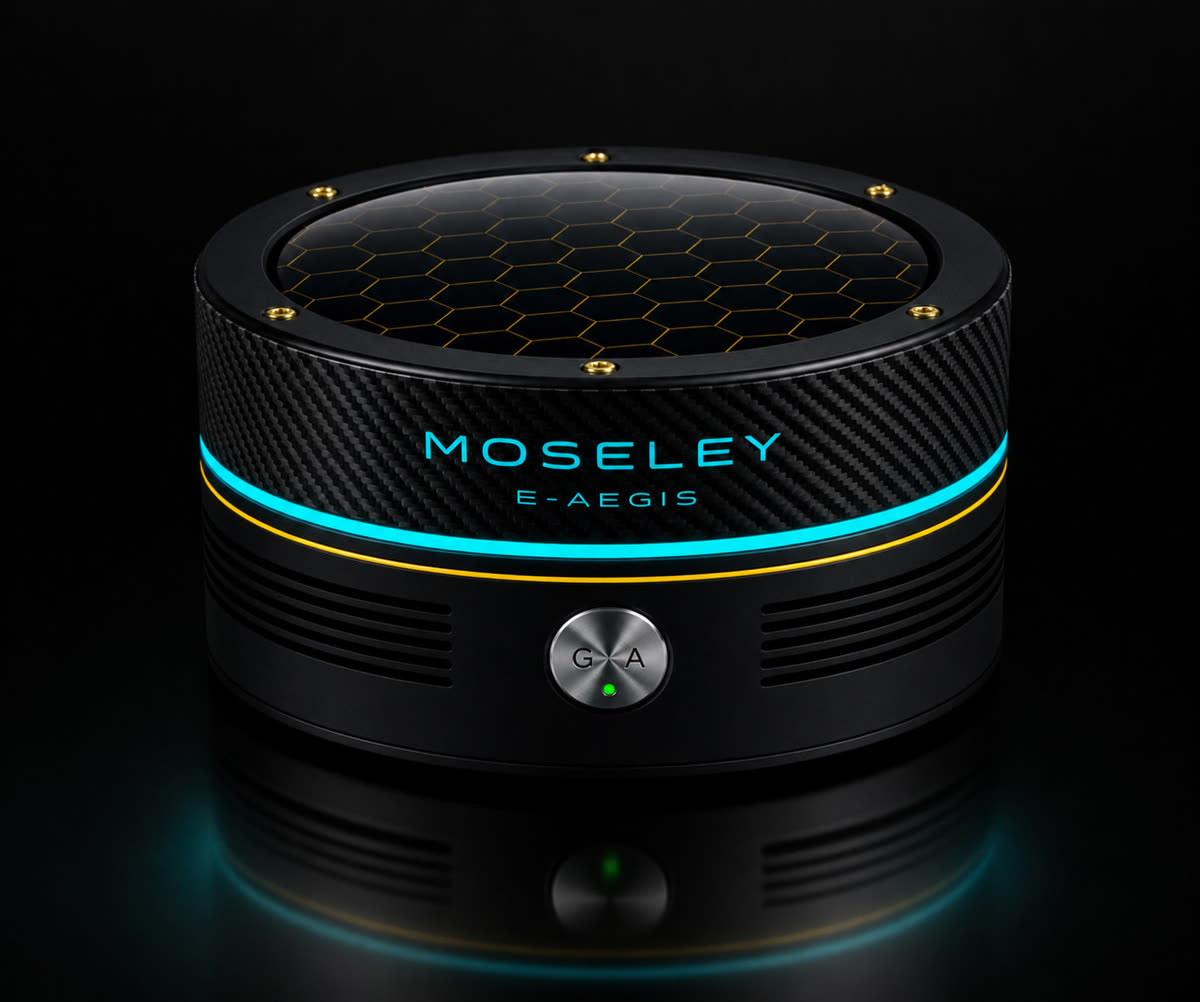
The Moseley E-Aegis is a single self-powered device that draws an ambient air sample, conditions it, senses ethylene and accompanying contaminants down to the parts-per-billion range, decides what to do under on-device machine-learning gating, and remediates — all in one autonomous unit. Inside, the device is built as three independent layers (E-Conditioning, E-Array, E-Remediation), each modifiable for the deployment.
▶ E-Aegis explainer · 0:52
FunctionSample → condition → sense → decide → remediate
TargetsC₂H₄, H₂O, NH₃, VOCs
Sensitivity0.01–10 ppm, LOD ~1 ppb
Decision layerOn-device ML · ML-gated remediation
Operational life≥ 42 days without external charging
PowerAmbient-energy harvester + battery
ConnectivityBLE 5.3 · LoRa optional
Operating range−20 °C to +40 °C
ComplianceCE · FCC · RoHS · IATA-safe
Use casesReefer containers · trailers · cool rooms · DCs · CA chambers · pharma
Inside the E-Aegis: condition, sense, remediate — each layer independently tunable.
The E-Aegis is built as three independent, modifiable layers that work as one device. Each layer can be retuned or substituted for the deployment — high-humidity sea container, packing shed, ripening room, distribution centre — without redesigning the others. The layers are part of the E-Aegis, not standalone products.
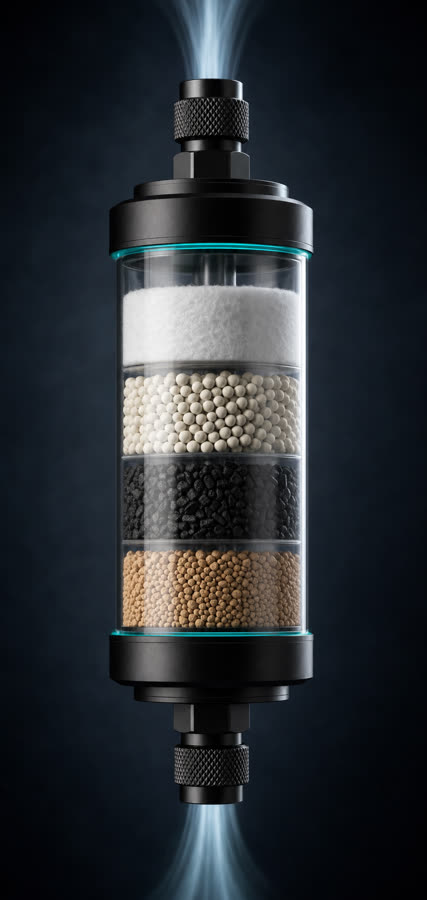
A configurable conditioning stack — particulate filter, heated silica desiccant, oxygen scrubber, sulfur guard — removes humidity swings, dust and the cross-reactive interferents that confuse ethylene chemistry before any sensing happens. Setpoint humidity control and configurable bed depth let the layer be retuned per deployment.
▶ Layer 1 explainer · 0:44
FunctionFilter → desiccate → O₂ scrub → S guard
TunableBed depth · regen schedule · RH setpoint
FeedsConditioned sample to E-Array
Layer 2 · E-Array
Metal-cystine sensing array with ML fusion.
A multi-channel array built around metal-cystine coordination chemistry (Cu, Fe, Co, Ni, Zn or Mn) coupled to piezoelectric resonators and chemiresistive elements in parallel. A teacher-student ML fusion turns the multi-channel response into a single confidence-scored ethylene trajectory. Array geometry, metal selection and channel count are reconfigurable per application.
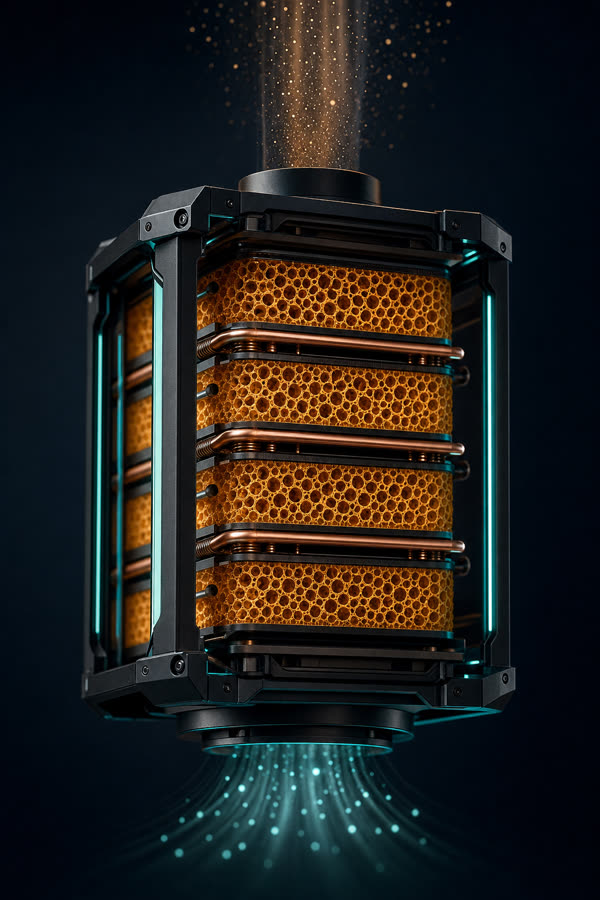
A stay-open multi-bed adsorbent module with receptor-in-host architecture (metal-cystine coordination sites dispersed in a MOF support). Beds are engaged only when the sensing layer's ML model decides remediation capacity is warranted, conserving sorbent life for the temperature-excursion moments that matter. Thermal regeneration and bed-state telemetry support the 42-day-plus operational life.
▶ Layer 3 explainer · 0:52
ArchitectureReceptor-in-host, ≥ 2 beds, ML-gated
RegenThermal regen · bed-state telemetry
Life floor≥ 42 days without service
ReceivesGate signal from E-Array
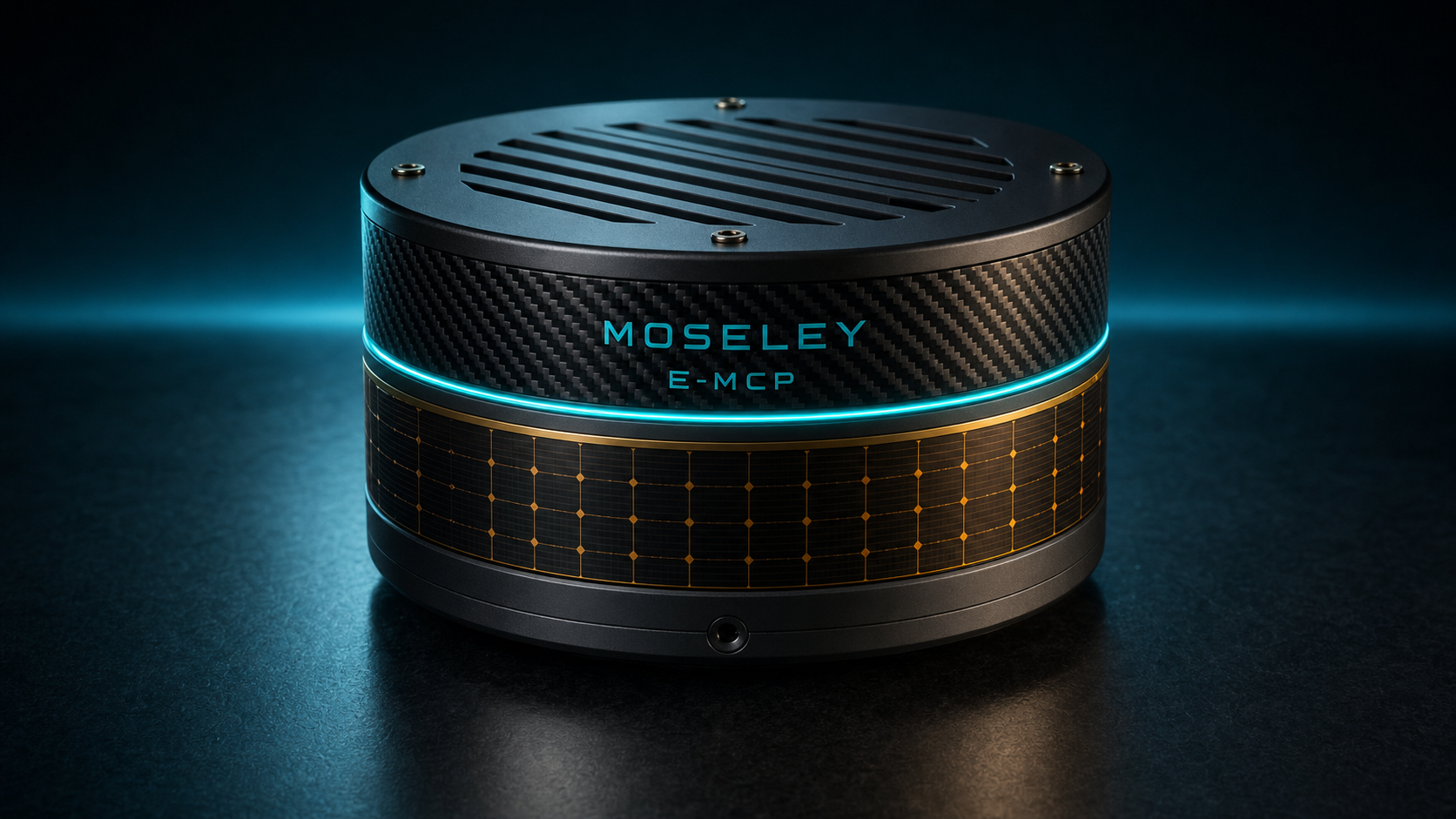
E-MCP · distributed controlled-release node · deployed inside the cargo space
E-MCP · AP32-E-MCP-AU01 Pilot · In progress · confidential
Distributed controlled release of the ethylene-action payload, with on-board self-sensing.
The E-MCP is a hockey-puck-sized autonomous release node that sits on top of pallets inside refrigerated containers, cold rooms and ripening rooms. A sealed cartridge holds an ethylene-action payload bound to a metal-organic-framework matrix; a heater beneath the cartridge releases payload on demand, a rotating-disc shutter and condensation-protected vent dispense vapour into the headspace, and a flat battery pack augmented by an organic-photovoltaic sidewall delivers a 42-day operational floor. A sealed, periodically-gated sensing cavity — carrying a MOF + biomimetic ethylene receptor and a gravimetric sensing element such as a quartz crystal microbalance — lets the node read its own headspace on a duty cycle and self-trigger release through an on-device inference engine. Nodes operate autonomously or under E-Aegis orchestration, with release events gated by predicted climacteric progression rather than absolute ppb thresholds.
Distributed biological sensing across the cold chain.
Moseley E-Nose Pilot · In progress · confidential
Distributed biological sensing.
The Moseley E-Nose continuously captures ethylene-response behaviour and environmental headspace signals to monitor how produce is biologically changing in real time.
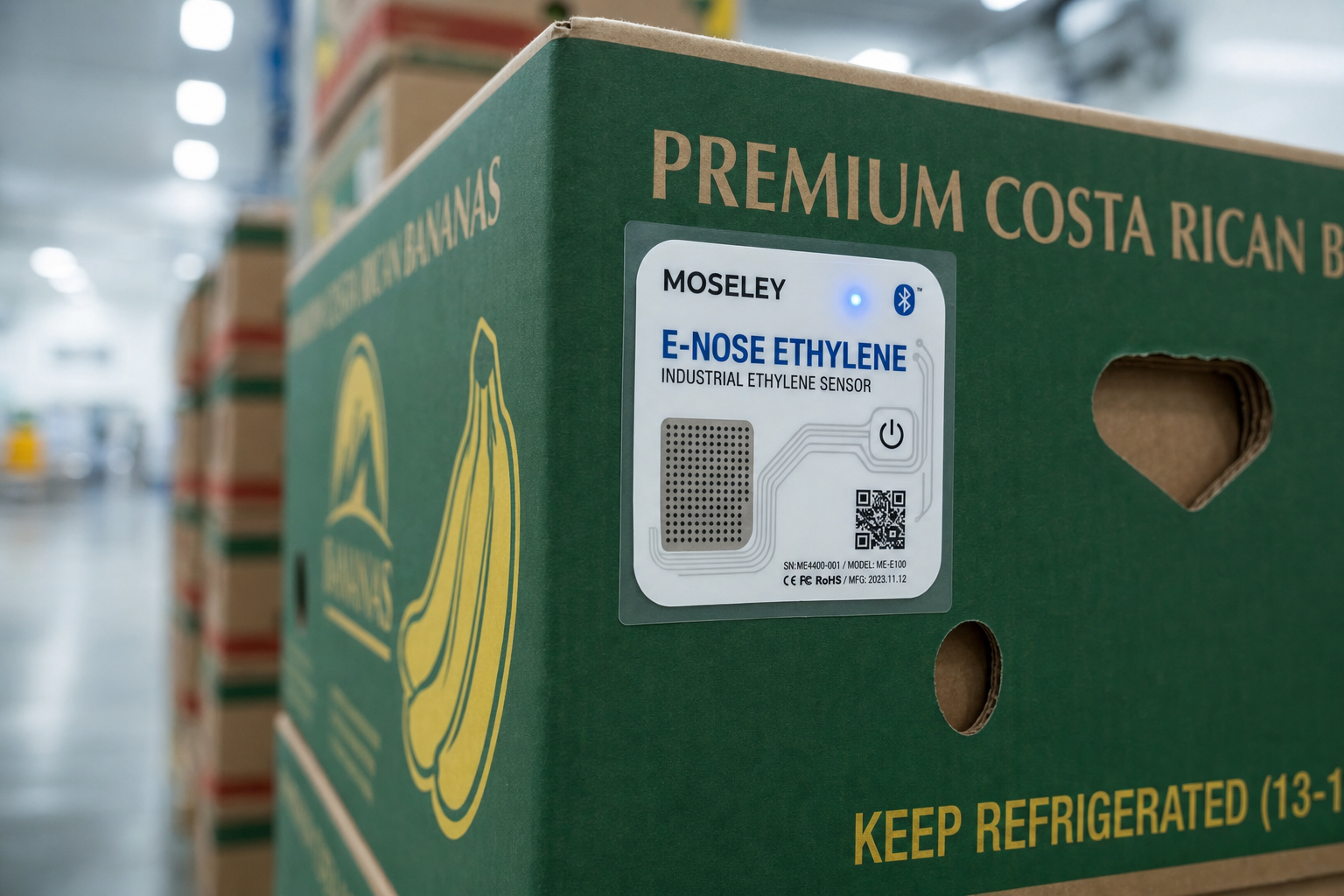
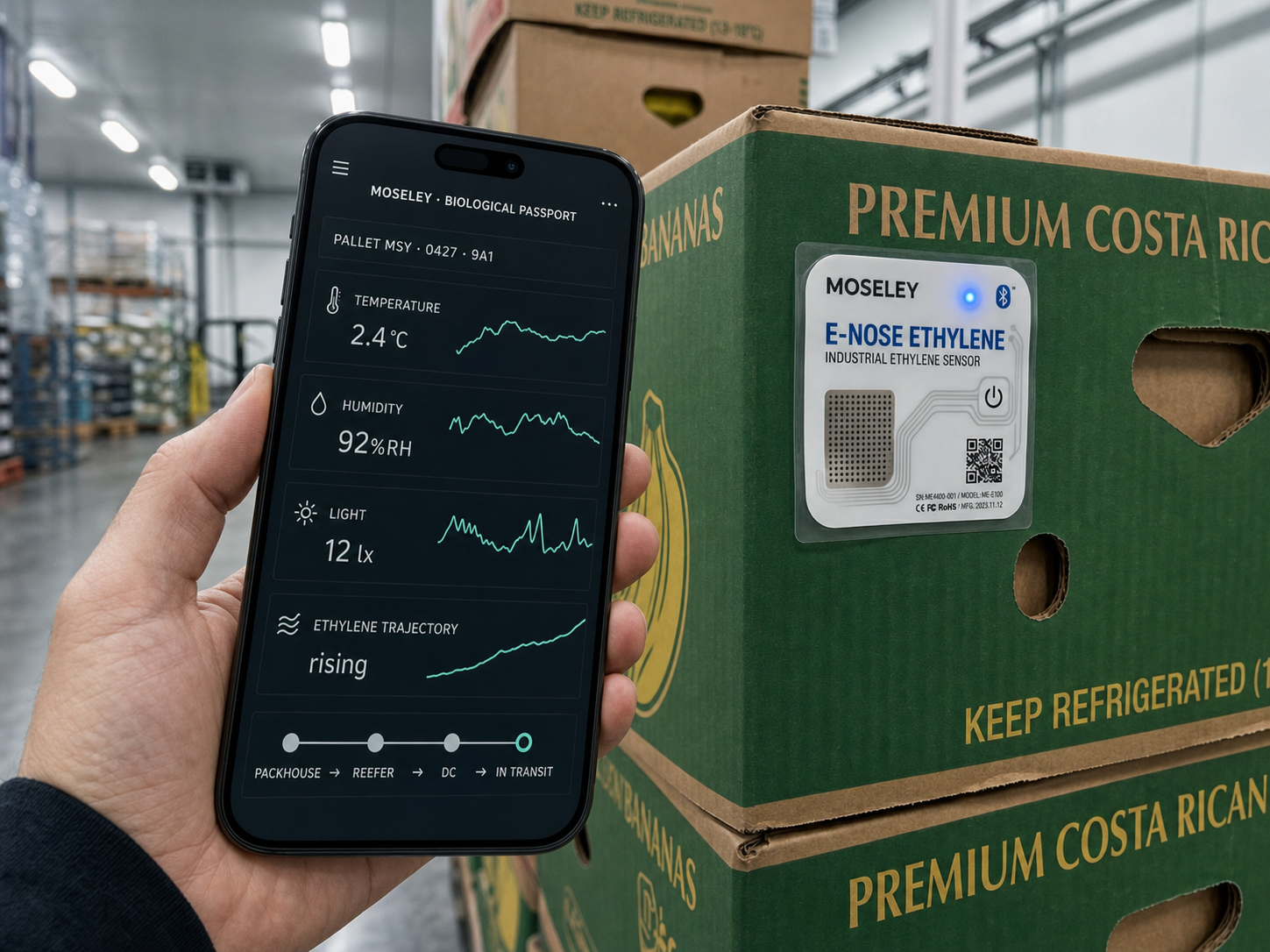
E-Nose label adhered to the outside of a banana carton — real-world deployment.
Deployment
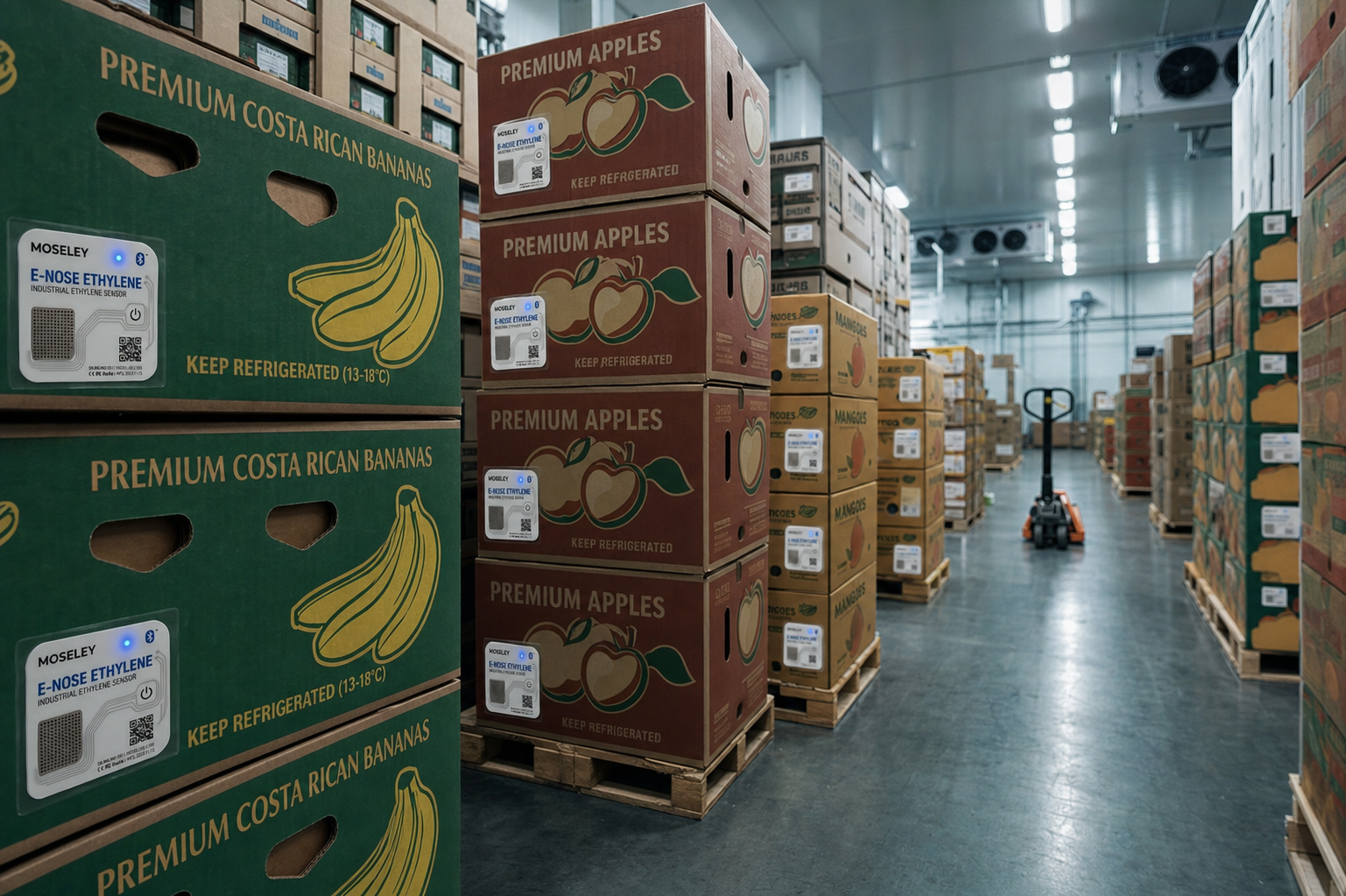
Biological intelligence at pallet scale.
Distributed E-Nose labels continuously monitor produce respiration and ethylene-response behaviour throughout the cold chain. The platform captures ethylene-response behaviour, temperature, humidity, light exposure and environmental trajectory data.
CapturesEthylene-response behaviour
CapturesTemperature
CapturesHumidity
CapturesLight exposure
CapturesEnvironmental trajectory
ScalePer pallet · per carton
How it works · Sense · Store · Forward · Predict
Four steps, infrastructure-free.
E-Nose → E-Aegis / Gateway → E-Sentinel Cloud.
01 · SenseCapture biological headspace signals and ethylene-response behaviour.
02 · StoreBuffer telemetry locally during disconnected operation.
03 · ForwardUpload through infrastructure-free opportunistic communications when pathways become available.
04 · PredictFeed E-Sentinel ML to reconstruct ripening and spoilage trajectories.
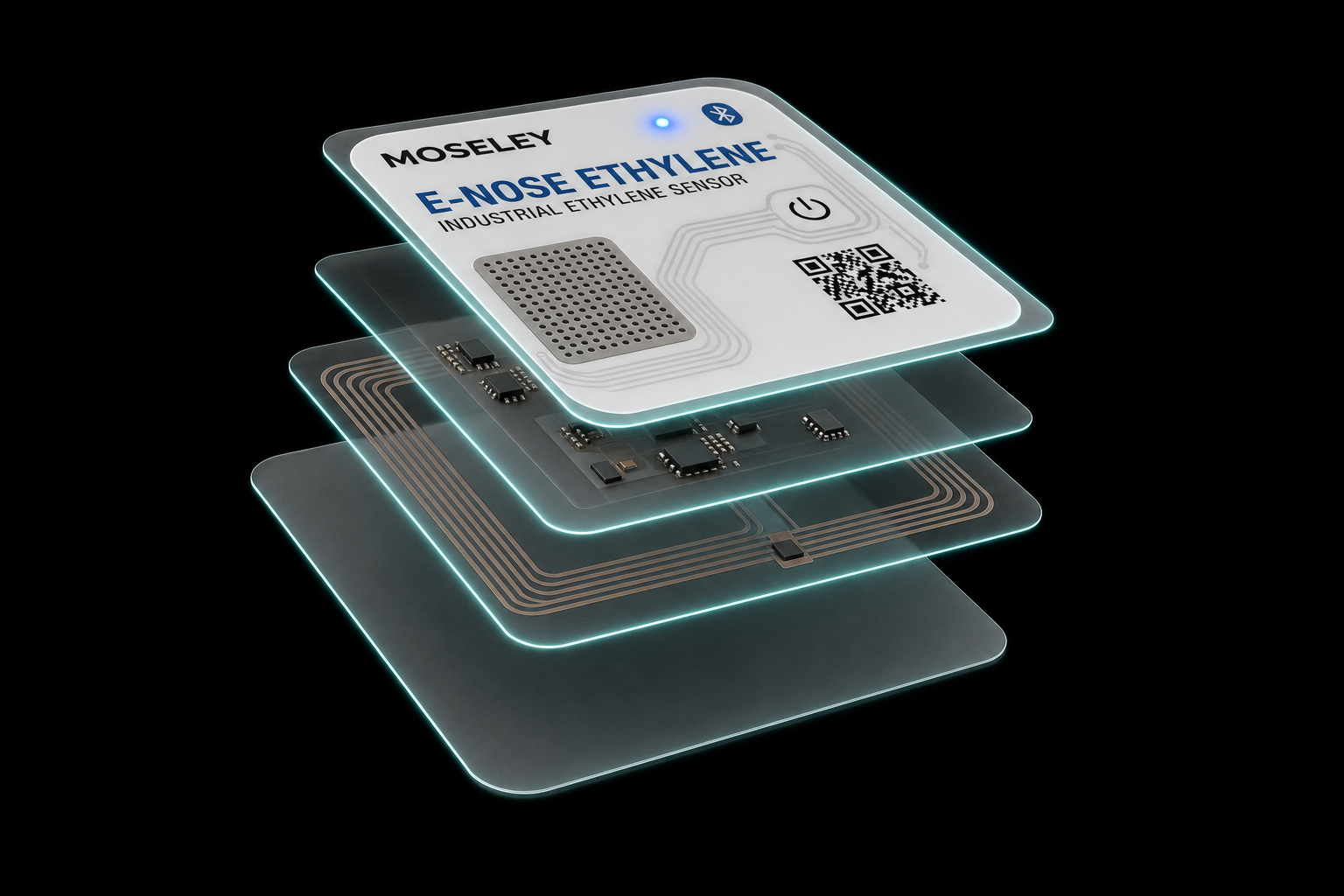
The E-Nose combines sensing, embedded intelligence, environmental monitoring and infrastructure-free communications within an ultra-low-profile smart label architecture designed for large-scale produce deployment.
Layer 01Sensor layer
Layer 02Embedded intelligence
Layer 03Communications layer
Layer 04Smart packaging architecture
Biological passport — temperature, humidity, ethylene trajectory and journey timeline for every pallet.
Biological passport
A biological passport for every pallet.
Scanning the QR code on an E-Nose label provides access to the environmental and biological history of the pallet — temperature history, humidity history, ethylene trajectory, journey timeline and produce condition insights.
ViewTemperature history
ViewHumidity history
ViewEthylene trajectory
ViewJourney timeline
ViewProduce condition insights
The Moseley principle
The platform measures how produce is biologically responding to its environment — not just the environment around it.
The Moseley difference
Existing systems measure the environment. Moseley measures the biology.